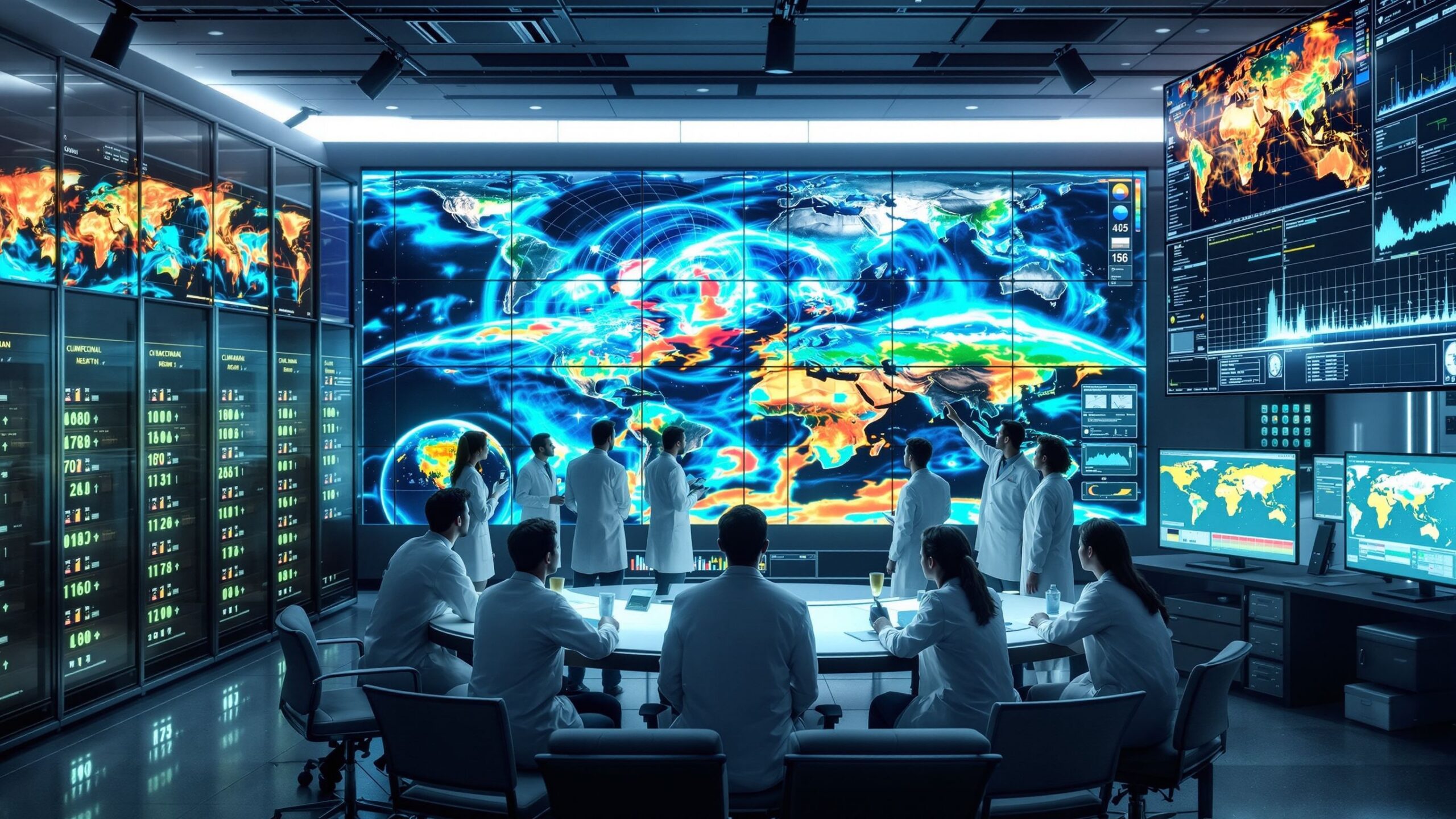
Climate predictions are among the most powerful tools scientists use to understand Earth’s future. Every year, researchers collect enormous amounts of environmental data and use sophisticated computer models to forecast how the planet’s climate may change over months, years, decades, and even centuries. These predictions help governments, businesses, farmers, engineers, and communities prepare for potential changes in temperature, rainfall, sea levels, and extreme weather events. As climate change continues to influence natural systems around the world, understanding the science behind climate predictions has become increasingly important. While predicting the future may sound like something from science fiction, climate predictions are rooted in well-established scientific principles, decades of observations, and some of the most advanced technology ever created.
A: It is a scientific estimate of how climate conditions may change over months, years, decades, or centuries.
A: Weather forecasts focus on short-term conditions, while climate predictions focus on long-term patterns and trends.
A: Scientific observations, physical laws, historical records, and computer models make climate prediction possible.
A: Comparing many models helps identify common patterns and measure uncertainty.
A: No. They provide likely outcomes based on current knowledge and available data.
A: Oceans store and transport huge amounts of heat, influencing weather and climate worldwide.
A: They trap heat in the atmosphere and significantly affect future climate conditions.
A: It is a collection of model simulations used to estimate possible future outcomes.
A: Yes. They help guide planning for droughts, floods, heat waves, storms, and sea-level rise.
A: By understanding how Earth's systems work today and how they worked in the past, scientists can estimate how they may behave in the future.
What Are Climate Predictions?
Climate predictions are scientific estimates of future climate conditions based on current knowledge of Earth’s climate system. Unlike weather forecasts, which focus on short-term atmospheric conditions, climate predictions examine long-term patterns and trends. Scientists use climate predictions to estimate how average temperatures, precipitation patterns, ocean conditions, sea levels, and other environmental factors may change over time. These predictions are not attempts to forecast the exact weather on a particular day years from now. Instead, they focus on identifying broader changes that may occur across regions or the entire planet. Climate predictions help answer questions about how future climates may differ from today’s conditions and what impacts those changes could have on natural and human systems.
Understanding the Difference Between Weather and Climate
One of the most important concepts in climate science is the distinction between weather and climate. Weather refers to short-term atmospheric conditions such as temperature, humidity, precipitation, wind speed, and cloud cover. Weather forecasts generally cover periods ranging from a few hours to several weeks. Climate, on the other hand, describes long-term patterns and averages of weather over decades or longer. A useful comparison is to think of weather as a single event and climate as the overall pattern created by many events. While weather forecasts focus on immediate conditions, climate predictions examine long-term trends. This difference explains why scientists can make meaningful climate predictions decades into the future even though detailed weather forecasts become less reliable after several days.
The Foundation of Climate Science
Climate predictions are built upon a deep understanding of how Earth’s climate system functions. Scientists know that climate is influenced by interactions among the atmosphere, oceans, land surfaces, ice sheets, vegetation, and incoming solar energy. These components continuously exchange heat, moisture, gases, and energy. The behavior of these systems follows physical laws that have been studied and tested for centuries. Principles such as thermodynamics, fluid dynamics, radiation transfer, and energy conservation provide the scientific foundation for climate predictions. Because these laws remain consistent over time, scientists can use them to simulate how climate systems respond to changing conditions.
The Greenhouse Effect and Climate Predictions
One of the most important scientific principles behind climate predictions is the greenhouse effect. Certain gases in Earth’s atmosphere, including carbon dioxide, methane, nitrous oxide, and water vapor, trap heat that would otherwise escape into space. This natural process keeps the planet warm enough to support life. Human activities such as burning fossil fuels, deforestation, and industrial processes have increased concentrations of greenhouse gases in the atmosphere. Scientists understand how these gases interact with radiation and influence Earth’s energy balance. Because the relationship between greenhouse gases and warming is well established, researchers can use this knowledge to estimate how future emissions may affect global temperatures and climate conditions.
Collecting Climate Data
Accurate climate predictions depend on high-quality environmental data. Scientists gather information from thousands of sources around the world. Weather stations record temperature, precipitation, humidity, and wind conditions. Satellites monitor cloud cover, atmospheric composition, sea surface temperatures, and ice coverage. Ocean buoys measure water temperature, salinity, and ocean currents. Research vessels, aircraft, weather balloons, and ground-based sensors provide additional observations. Historical records are equally important because they allow scientists to identify long-term climate trends and natural variability. The vast amount of data collected helps researchers understand how Earth’s climate has changed in the past and how it may evolve in the future.
Climate Models: Virtual Earths Inside Computers
At the heart of climate prediction are climate models. These advanced computer programs simulate Earth’s climate system using mathematical equations that represent physical, chemical, and biological processes. Climate models divide the planet into millions of three-dimensional grid cells. Each cell contains information about local conditions such as temperature, humidity, atmospheric pressure, ocean properties, and land characteristics. The model continuously calculates how conditions within each cell interact with neighboring areas. Through billions of calculations, the model recreates the behavior of Earth’s climate system. Scientists often describe climate models as virtual Earths because they allow researchers to conduct experiments and explore future scenarios within a digital environment.
How Supercomputers Make Climate Predictions Possible
Climate prediction requires extraordinary computing power. Modern climate models perform enormous numbers of calculations to simulate interactions among atmosphere, oceans, land, and ice. Even a single climate simulation may require trillions of mathematical operations. Supercomputers make these calculations possible by using thousands of processors working simultaneously. Some climate simulations run continuously for weeks or months before producing results. Advances in computing technology have dramatically improved climate prediction capabilities. Modern supercomputers allow scientists to create higher-resolution simulations that capture smaller-scale climate processes and provide more detailed projections than ever before.
Understanding Climate Scenarios
A key part of climate prediction involves the use of scenarios. A climate scenario is a possible future pathway based on specific assumptions about factors such as population growth, energy use, economic development, technological progress, and greenhouse gas emissions. Scientists create multiple scenarios because they cannot predict exactly how society will behave in the future. Some scenarios assume rapid reductions in greenhouse gas emissions, while others explore futures where emissions continue to increase. Climate models are run using these different assumptions to estimate how climate conditions may respond under various circumstances. Comparing scenarios helps researchers understand the range of possible futures and the influence of human decisions on climate outcomes.
Natural Climate Variability
Earth’s climate naturally changes over time, even without human influence. Volcanic eruptions, changes in solar activity, ocean circulation patterns, and atmospheric oscillations can all affect climate conditions. Events such as El Niño and La Niña influence weather and climate around the globe. Climate predictions must account for these natural variations while also considering long-term human-driven influences. Distinguishing between natural variability and long-term climate trends is one of the major challenges in climate science. Scientists use historical records and advanced models to understand how these factors interact and contribute to observed climate changes.
Testing Climate Predictions
Scientists carefully test climate models before using them to make future projections. One common method is called hindcasting. In a hindcast, researchers start a climate model in the past using known environmental conditions and then compare the simulation results with actual observations. For example, a model might begin in 1900 and simulate climate changes throughout the twentieth century. Scientists then compare the model’s output with recorded temperatures, rainfall patterns, ocean conditions, and atmospheric measurements. If the model successfully reproduces known historical trends, confidence in its predictive abilities increases. Hindcasting has shown that many climate models accurately simulate major climate changes observed over the past century.
Why Climate Predictions Include Uncertainty
No scientific prediction is completely certain, and climate predictions are no exception. Earth’s climate system is extraordinarily complex, involving countless interactions among environmental components. Some processes occur on scales that are difficult to represent perfectly within computer models. Future human behavior also introduces uncertainty because scientists cannot know exactly how governments, industries, and populations will respond to climate challenges. As a result, climate predictions typically present ranges of possible outcomes rather than single forecasts. These ranges help communicate both confidence and uncertainty while providing realistic expectations about future conditions.
Predicting Global Temperature Changes
One of the most widely discussed aspects of climate prediction involves future temperature changes. Scientists use climate models to estimate how global temperatures may respond to increasing greenhouse gas concentrations. These projections consistently indicate that temperatures will continue rising if greenhouse gas emissions remain elevated. While the exact amount of warming depends on future emissions and other factors, the overall trend is supported by extensive scientific evidence. Temperature predictions help researchers evaluate potential impacts on ecosystems, agriculture, water resources, and human health.
Forecasting Changes in Rainfall and Water Resources
Climate predictions also examine future precipitation patterns. Rising temperatures influence evaporation, atmospheric moisture, and storm behavior, which can alter rainfall distribution around the world. Some regions may experience increased precipitation, while others may become drier. Changes in rainfall can affect water supplies, agriculture, ecosystems, and infrastructure. Scientists use climate predictions to help communities prepare for potential shifts in water availability and manage resources more effectively. Understanding future precipitation patterns is especially important in regions vulnerable to droughts or flooding.
Predicting Sea-Level Rise
Sea-level rise is another major focus of climate predictions. As global temperatures increase, glaciers and ice sheets lose mass, and seawater expands as it warms. Both processes contribute to rising sea levels. Climate models help scientists estimate how quickly sea levels may rise under different scenarios. These projections are critical for coastal communities, urban planners, and governments responsible for protecting infrastructure and managing flood risks. Predicting sea-level changes allows decision-makers to develop adaptation strategies that reduce future vulnerabilities.
Understanding Extreme Weather Risks
Climate predictions are increasingly used to assess future risks associated with extreme weather events. Although scientists cannot predict individual storms decades in advance, they can estimate how the frequency and intensity of certain types of extreme events may change. Research suggests that many regions may experience more frequent heat waves, heavier rainfall events, longer droughts, and increased wildfire risks as the climate changes. These predictions help communities improve emergency preparedness, infrastructure design, and disaster response planning. Understanding future risks allows societies to become more resilient to changing environmental conditions.
The Role of Artificial Intelligence in Climate Science
Artificial intelligence is becoming an increasingly valuable tool in climate prediction. Machine learning algorithms can analyze enormous datasets, identify patterns, and improve forecasting techniques. Researchers are using artificial intelligence to enhance climate models, process satellite observations, and develop faster methods for analyzing climate information. While traditional climate models remain essential, artificial intelligence is helping scientists improve efficiency and uncover new insights that may further strengthen prediction capabilities in the future.
The Future of Climate Predictions
Climate prediction technology continues to advance rapidly. New generations of climate models are being developed with higher resolution, improved physics, and more realistic representations of Earth’s systems. Future supercomputers will allow scientists to simulate climate processes with unprecedented detail. Expanded satellite networks and environmental monitoring systems will provide even more accurate data for model development and validation. Artificial intelligence and advanced analytics will continue improving forecasting methods. These innovations promise to make climate predictions more precise, informative, and useful for decision-makers around the world.
Conclusion
The science behind climate predictions combines decades of research, advanced technology, and a deep understanding of Earth’s climate system. By using environmental observations, established physical laws, powerful climate models, and sophisticated computing systems, scientists can estimate how climate conditions may change in the future. While uncertainties remain, climate predictions provide valuable insights into potential temperature changes, rainfall patterns, sea-level rise, and extreme weather risks. These forecasts help governments, businesses, and communities prepare for future challenges and make informed decisions. As technology continues to evolve and scientific knowledge expands, climate predictions will become even more accurate and valuable, helping humanity better understand and navigate an ever-changing world.