The atmosphere’s carbon balance depends partly on forests
Human activity adds carbon dioxide to the atmosphere, but not all of that additional carbon remains there. Land ecosystems and the ocean absorb part of it, moderating the increase that would otherwise occur. Forests are central to the land side of that exchange because they combine extensive leaf area, large woody structures, and carbon-rich soils across enormous regions. Their importance has two dimensions: they hold carbon accumulated in the past, and many continue taking up additional carbon today. Losing an established store and weakening future uptake can therefore affect the climate together. Yet neither role makes forests an unlimited counterweight to fossil fuel use. Their influence depends on climate, land use, disturbance, and the length of time carbon stays stored. Seeing forests within the global budget explains why conserving them is a major climate priority and why their contribution works alongside, rather than replaces, emissions reductions.
A: Pan and colleagues estimated about 3.5 billion tonnes of carbon a year, before subtracting the separately reported tropical deforestation emissions.
A: It may retain a large carbon store whose loss would have substantial consequences.
A: No. Rebuilding comparable stores takes time and may not reproduce all pools.
A: No. Moisture, soils, disturbance, and land use create major differences.
A: Growth responses are limited by water, nutrients, and other stresses.
A: Dead wood can continue decomposing after the initial disturbance, while the surviving forest grows and new vegetation establishes.
A: No; it can add carbon uptake but does not recreate the lost site's habitats, water relationships, or community connections.
A: No. Disturbance and changing land use can reverse storage gains.
A: No. Ecological suitability, existing carbon, water, and community rights matter.
A: Sustained reductions in fossil and other greenhouse-gas emissions are essential.
A three-decade study puts the forest contribution in perspective
A 2024 study led by Yude Pan assembled forest observations across boreal, temperate, and tropical regions for 1990–2019. It estimated a forest sink of 3.6 billion tonnes of carbon a year in the 1990s and 2000s, and 3.5 billion in the 2010s, with uncertainty of about 0.4 billion in each estimate. These are tonnes of carbon, not tonnes of carbon dioxide. They show that uptake by forests is large enough to matter within the global carbon budget.
Over the same study period, tropical deforestation released an estimated 2.2 billion tonnes of carbon annually, offsetting roughly two-thirds of the forest sink. Forest growth and forest loss were therefore pulling the atmospheric balance in opposite directions. The uptake figure describes carbon entering the assessed forests, while the deforestation emissions describe part of what was leaving through land conversion. Protecting forests matters on both sides of that exchange: keeping the store and retaining the trees that perform future uptake.
Picture the difference between an expanding tree and a cleared hillside. The first gradually incorporates additional atmospheric carbon into living material. On the second, burning and decomposition can return part of a previously accumulated store, while the removed canopy no longer performs its earlier uptake. Adding the two processes together answers a different question from measuring growth in the trees that remain.
Behind a broadly stable global total, forests were changing in different ways. Recovering woodland could add carbon while another region lost trees or experienced weaker growth. Regrowth elsewhere did not move the lost forest’s soil, wildlife, water relationships, or community resources into the recovering site. A carbon gain can contribute to the global balance while the loss of a particular ecosystem still damages the place where it occurred. Forest conservation therefore has local consequences as well as an atmospheric effect shared across the planet.
Keeping accumulated carbon is a climate service of its own
An existing forest contains carbon that would affect the atmosphere differently if the land were cleared, burned, drained, or repeatedly disturbed. Retaining that stock avoids some releases that would occur under those alternative conditions. This protective role is distinct from the addition of new carbon each year. A forest need not exhibit the fastest growth rate to be important: a large, vulnerable store can warrant protection even when its annual net uptake is modest. Replacing it with a rapidly growing stand does not instantly reproduce the carbon already present in large trees, dead material, and soils. The atmosphere experiences the timing of losses and recovery, and a long rebuilding period matters during a period of urgent emissions reduction. Keeping a stock intact is therefore more than preserving a historical number on an inventory sheet.
Different forest regions contribute through different strengths
Humid tropical forests can support high productivity where warmth and moisture permit growth over much of the year. Their large living biomass makes land conversion especially consequential, while drought and degradation can undermine the conditions supporting uptake. Tropical forests also vary greatly in soils, species, seasonality, and disturbance history. Treating the tropics as one uniform carbon engine misses those differences. A wet lowland forest and a seasonally dry forest face different limits and respond differently to unusual weather.
Temperate forests often reflect long histories of clearing, management, and regrowth. Recovery after past disturbance can contribute to increasing stocks, alongside changes in growth conditions and management. Boreal forests have a different balance again, with extensive underground and dead-organic stores and strong constraints imposed by cold conditions. Where organic soils are involved, warming, drainage, or fire can have consequences that extend beyond the visible trees. Comparing regions therefore requires attention to the whole ecosystem and its history, not only how tall or green the canopy appears.
Old forests and recovering forests answer different needs
Recovering forests can add carbon as vegetation reoccupies suitable land and trees increase in size. That makes natural regeneration and well-designed restoration useful components of climate action. Establishment still depends on water, seed sources, browsing pressure, land tenure, and the compatibility of trees with the local ecosystem. A planting campaign does not create a mature carbon store on the day seedlings enter the ground. Survival, continued growth, and long-term protection determine the eventual result.
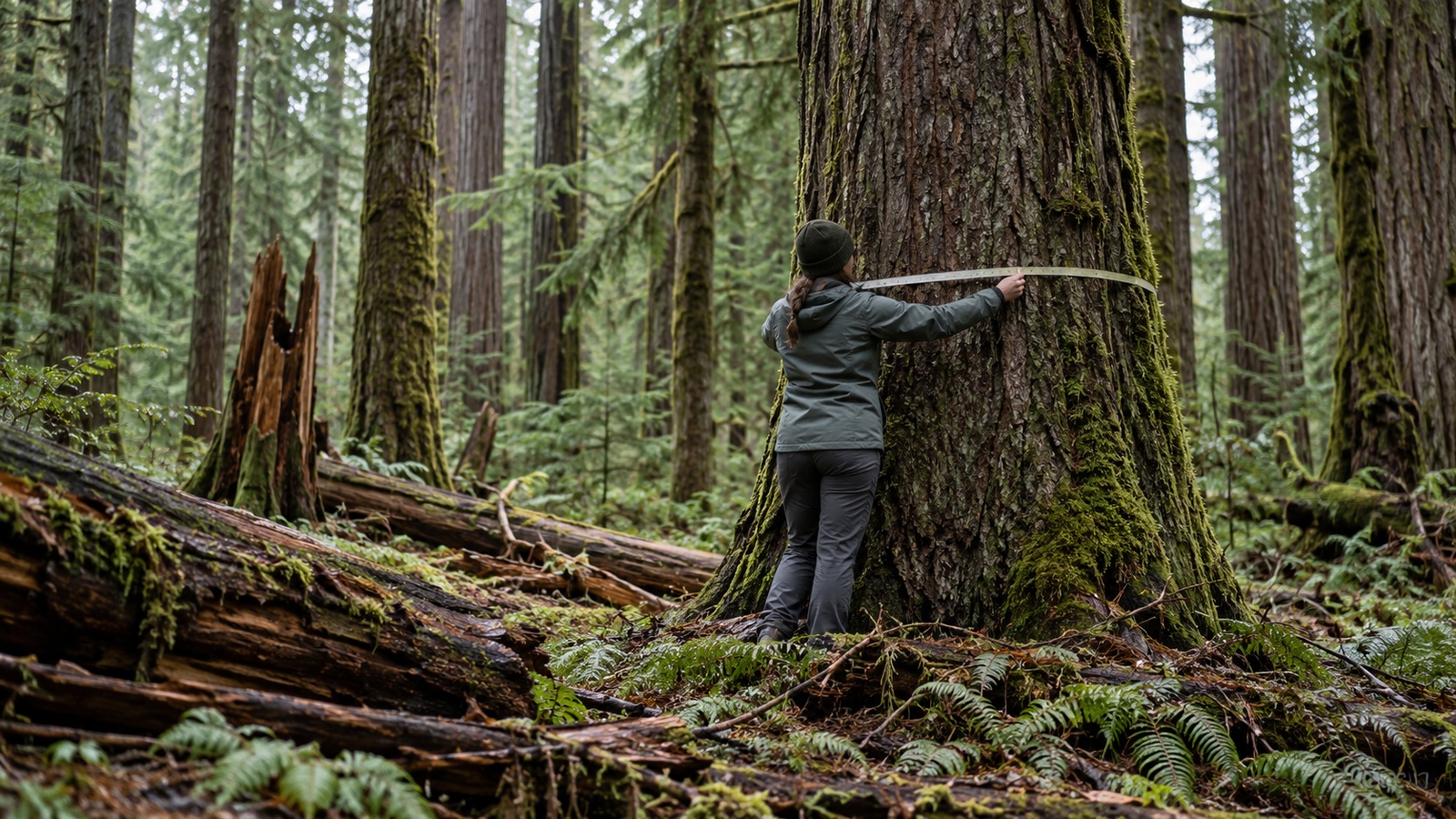
Older forests can contain stores that took centuries to develop, while their living trees and soils may continue participating in net uptake. Age alone does not tell the entire carbon balance, and no universal age marks the point at which all forests become climatically irrelevant. Mortality, growth, regeneration, and decomposition operate together. A landscape with large old trees, young recruits, and substantial dead wood is not equivalent to a uniformly aged plantation. Its distribution of carbon and habitat reflects a different ecological history.
A landscape can contain both established carbon-rich stands and areas recovering after earlier disturbance. Keeping the former prevents the loss of material already accumulated, while allowing the latter to recover builds additional vegetation over time. Seedlings cannot immediately replace the carbon in a large old tree, and a young stand needs repeated seasons of survival and growth before its structure develops. These differences give protection and restoration complementary roles. One maintains an existing store and living ecosystem; the other rebuilds a system where conditions still allow forest to return.
Weather can weaken a sink without changing the forest boundary
A forest can remain on the map while its carbon uptake weakens. Drought restricts photosynthesis when trees close leaf pores to conserve water, while unusual heat can increase stress and alter respiration. Some trees recover when conditions improve; others lose branches or die, leaving material that decomposes over subsequent years. Fire can release carbon quickly and damage vegetation that would otherwise continue growing. The spacing of disturbances matters because a second event can arrive before roots and foliage have recovered from the first. More atmospheric carbon dioxide can stimulate growth under some conditions, but trees also need water, nutrients, and suitable temperatures to use that opportunity. A developing canopy may consequently face a combination of extra carbon supply and tighter limits on growth. Below ground, warming or altered moisture can change how quickly decomposers process stored material. These linked responses make the forest an active participant in climate change as well as a place exposed to it. Maintaining a strong sink depends on living conditions that support continued growth and on enough time between major losses for the ecosystem to recover.
Forest carbon and fossil carbon follow different clocks
Burning coal, oil, and gas adds carbon that was held in geological deposits to the active atmosphere–ocean–land cycle. A growing forest takes some atmospheric carbon into wood, roots, and soil, where its residence can range from a short growing season to much longer periods. That biological store remains exposed to decay, fire, and land-use change. If the forest later releases the carbon, the earlier uptake has delayed its return rather than kept it out indefinitely. The IPCC’s land-mitigation assessment places forest protection and restoration within a wider effort to reduce greenhouse-gas emissions.
Maintaining a forest store keeps carbon out of the atmosphere for the time it remains retained. That can make a valuable contribution while fossil emissions fall, especially when protection prevents a large near-term loss. Repeated disturbance weakens that contribution by returning material before it can be replaced. Rebuilding the store takes growth, suitable land, and time, while continued fossil combustion adds further carbon during the rebuilding period. Forest conservation and emissions cuts therefore address connected but different parts of the climate problem. Neither a fast-growing plantation nor an old forest can provide an unlimited destination for continuing fossil carbon.
Tropical regrowth illustrates why recovery and protection belong together
A field left after agriculture can begin a very different carbon trajectory when woody vegetation returns. New stems and expanding roots build a store that was smaller while the land remained cleared. Seed sources, the condition of the soil, and continued access to water influence how that recovery proceeds. The resulting young forest develops through years of establishment and competition, rather than acquiring the structure of an old forest at the moment land use changes.
Pan and colleagues found opposing tropical trends over their three-decade assessment: the sink in regrowing tropical forests increased, while the sink in intact tropical forests declined. The distinction makes the strategy tangible. Supporting regrowth can add uptake, but it does not make continued loss of established forest harmless. The regional gains and losses were moving in different directions inside an apparently steady global forest total.
On suitable land, recovering forest can reconnect surviving patches as new stems establish between them. Seeds arrive from nearby sources, roots explore formerly cleared soil, and competition gradually changes the canopy. Protection reduces further loss from the established woodland while recovery changes the condition of the cleared area. Early vegetation may differ substantially from the mature forest beside it, and some seedlings will fail before others develop into larger trees. Maintaining seed sources, water access, and space for regeneration helps that transition continue. The resulting carbon gain builds through the survival and growth of living plants rather than appearing in full at the start of restoration.
Carbon gains should fit the land and the people who depend on it
Putting trees into a naturally open ecosystem can damage biodiversity or change water availability without delivering the climate outcome implied by a simple tree count. Forest restoration is most defensible where the ecological setting and land-use history support it. Species choice, landscape connectivity, and resilience influence whether the new vegetation persists. Existing grasslands, peatlands, and other ecosystems also contain carbon and deserve assessment on their own terms. Climate action should improve the relevant land system rather than impose one visual definition of greenness everywhere.
People’s rights and livelihoods shape whether protection lasts. Indigenous Peoples and local communities may hold deep knowledge of forests alongside legal, cultural, and economic relationships to the land. Secure tenure, meaningful participation, and fair distribution of benefits can support stewardship, while exclusion can create conflict and injustice. Carbon accounting does not resolve those questions by itself. A durable forest strategy needs social legitimacy as well as sound ecological measurement, especially when outside funding changes control over resources that communities use and manage.
The strongest strategy protects sinks while shrinking the source
Forests matter because they retain accumulated carbon, take up additional carbon, and support the ecological conditions that can keep those functions operating. Protecting existing forests, reducing degradation, and enabling appropriate recovery can all contribute, but each has a different timetable and set of risks. None creates unlimited capacity to absorb continuing fossil emissions. A climate strategy must therefore work on both sides of the budget: reduce the flow entering the atmosphere and sustain the systems that remove or retain some of it. That approach also recognizes forests as living places with water, habitat, and cultural value. Their global importance becomes a reason for careful stewardship, grounded in realistic expectations about what biological carbon storage can achieve.