A hectare of forest can hold carbon in trees, dead material, and soil
The world’s forests held an estimated 662 billion tonnes of carbon in FAO’s Global Forest Resources Assessment 2020, averaging about 163 tonnes per hectare across the included pools. An individual forest can differ greatly from that global average. Large, long-lived trees can build substantial woody stores, while deep organic soils can hold carbon that is barely visible from the surface. A young stand on shallow ground has a different structure and history from an old, wet forest with large trunks and accumulated dead wood. The amount also changes as trees grow, branches fall, decomposers work, and disturbances remove material. Forest carbon storage is therefore a physical quantity distributed through several parts of an ecosystem. Measuring those parts reveals both how much a particular forest already contains and why rebuilding a lost store can take many years.
A: FAO's 2020 global assessment averaged about 163 tonnes of carbon per hectare across its included pools; an individual forest needs its own estimate.
A: They express corresponding masses using the molecular ratio 44/12.
A: Biomass estimates normally use dry mass, excluding variable water content.
A: Not directly. Soil estimates require appropriate additional observations and methods.
A: Carbon transfers from living biomass to dead material before later releases occur.
A: Concentration must be combined with soil mass, depth, and other relevant factors.
A: No. Existing stock and annual net change are different quantities.
A: Their tree sizes, disturbance histories, dead wood, and soils can differ even within a nearby area.
A: No. Sampling and model limitations can remain large despite many displayed digits.
A: It contains wood and organic matter accumulated across many seasons, while new vegetation begins with much smaller structures.
Measured examples show how widely forest stores can differ
The FAO 2020 assessment includes living biomass, dead wood, litter, and soil organic matter in its global forest total. These pools develop differently. Tree biomass depends on the vegetation present, while soil holds the results of repeated inputs and decomposition. Dividing the total stock by forest area gives the global average density, but individual hectares contain different proportions of the pools. A recently established woodland can have little large wood even where its soil retains organic material from earlier vegetation.
Some old mountain-ash forests contain exceptionally large biomass stores. Keith, Mackey, and Lindenmayer’s 2009 study reported an average of 1,867 tonnes of carbon per hectare in living and dead biomass at thirteen sampled old stands in Victoria’s Central Highlands, Australia. Large trees and accumulated dead material contributed to that result, which did not include a complete soil inventory. The difference from a global average reflects both the selected forest’s unusual structure and the particular pools counted. An old stand with very large trunks can hold an amount of carbon that is difficult to picture from the number of trees alone.
Carbon mass and carbon dioxide mass are different units
A tonne of carbon is not a tonne of carbon dioxide. Carbon dioxide includes oxygen as well as carbon, so the mass of carbon dioxide containing a given carbon mass is larger. The molecular-mass ratio is 44 divided by 12, approximately 3.67. Multiplying tonnes of carbon by this factor expresses the corresponding mass of carbon dioxide; dividing converts the other way. This is a change of units, not the creation of additional storage. It also does not mean carbon inside wood exists as bottled carbon dioxide. The carbon is incorporated into organic material, while the conversion provides a familiar basis for comparing quantities in a carbon account. Labels such as t C and t CO2 therefore carry essential information rather than being interchangeable abbreviations.
Area totals and carbon density tell different stories
Carbon density is the amount stored per unit of land, commonly expressed in tonnes of carbon per hectare. One hectare is 10,000 square meters. Multiplying density by area gives the total for a patch or region, so extent matters alongside the amount in each hectare. A small stand with high density can hold less total carbon than a vast region with a lower average. Within either area, trees, soil, and dead material account for the physical store. Density describes how concentrated it is across the land, while the total describes its overall size.
For a simple illustration, twenty hectares averaging 150 tonnes of carbon per hectare contain 3,000 tonnes of carbon. Multiplying that total by 44/12 expresses the same carbon as approximately 11,000 tonnes of corresponding carbon dioxide mass. The example uses assumed numbers to show how area and units connect. It does not add oxygen to the trees or change how much carbon they contain. The larger carbon-dioxide figure arises because each molecule includes oxygen as well as carbon. Keeping area, dry biomass, carbon mass, and carbon-dioxide mass distinct makes the arithmetic easier to follow.
A forest landscape rarely has the same density everywhere. Recently disturbed patches can contain young growth beside stands with larger trees, while a damp hollow and a rocky slope may have different soil stores. Inventories often group these conditions and combine their estimates in proportion to the area each occupies. A landscape with extensive mature woodland will then have a different total from one dominated by recently cleared or regenerating ground. Soil differences can change the pattern again, especially where shallow mineral soils occur beside deeper organic deposits.
Tree measurements become biomass through tested relationships
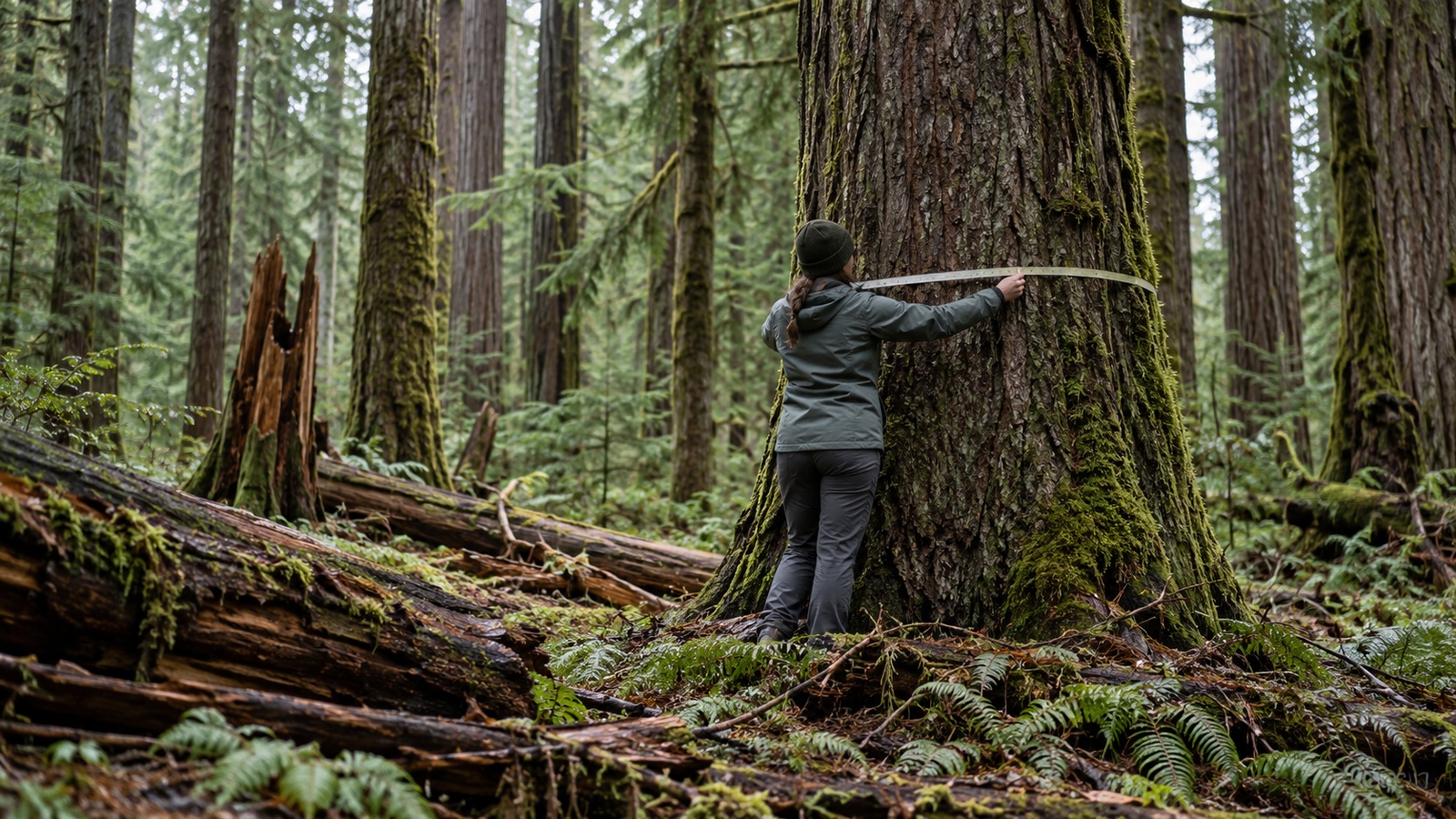
A tree’s trunk diameter, height, species, and wood density provide clues to its mass. Researchers use allometric equations, developed from measured trees, to connect those characteristics with an estimate of biomass. A wider trunk usually contains more material, but trees of similar diameter can differ in branching, height, and the density of their wood. Broken tops and multiple stems change the shape again. Field measurements therefore describe the particular tree that the equation represents. The resulting mass includes material that would be difficult to weigh without cutting the tree apart.
Biomass estimates normally refer to dry mass, avoiding the large and variable contribution of water. An appropriate carbon fraction then converts dry biomass to carbon mass. Some simplified calculations use approximately half the dry biomass, but species, tissue, and protocol can require more specific factors. Root biomass is often modeled rather than excavated, adding another source of uncertainty. The resulting estimate is a reasoned inference from measured features, not a direct weighing of every branch, root, and leaf in the forest.
An illustrative eight tonnes of dry biomass, with an assumed carbon fraction of one-half, contains four tonnes of carbon. Expressing that carbon as its corresponding carbon-dioxide mass gives about 14.7 tonnes. Water is excluded from the starting dry mass because it can change substantially without the tree gaining new structural material. A wet log can therefore weigh more than the same log after drying while containing essentially the same carbon in its remaining wood. The conversion follows the material rather than the moisture that temporarily adds to its weight.
Wood density explains why volume alone cannot finish the job. Two equally sized pieces of dry wood can have different masses because their structures differ. An equation calibrated for one species or forest form can consequently misrepresent another. Field identification and suitable density information connect the measured shape with the material it actually contains.
Underground stores demand a different sampling strategy
Soil carbon estimation typically combines carbon concentration with the mass of soil represented by the sample. Bulk density, layer thickness, and the proportion occupied by coarse fragments can all affect the conversion to carbon per area. A sample with a high carbon concentration does not necessarily imply the greatest stock if the soil mass or depth differs. Sampling design must also account for considerable spatial variability. Organic soils require suitable methods and can contain substantial carbon below the depth used in a shallow survey. Changes in soil mass can complicate repeated comparisons, so an equivalent-soil-mass approach may be appropriate when evaluating change. These details explain why the forest floor’s appearance cannot reveal the whole underground inventory and why comparing studies with different depth limits can be misleading.
Dead wood remains part of the forest's store
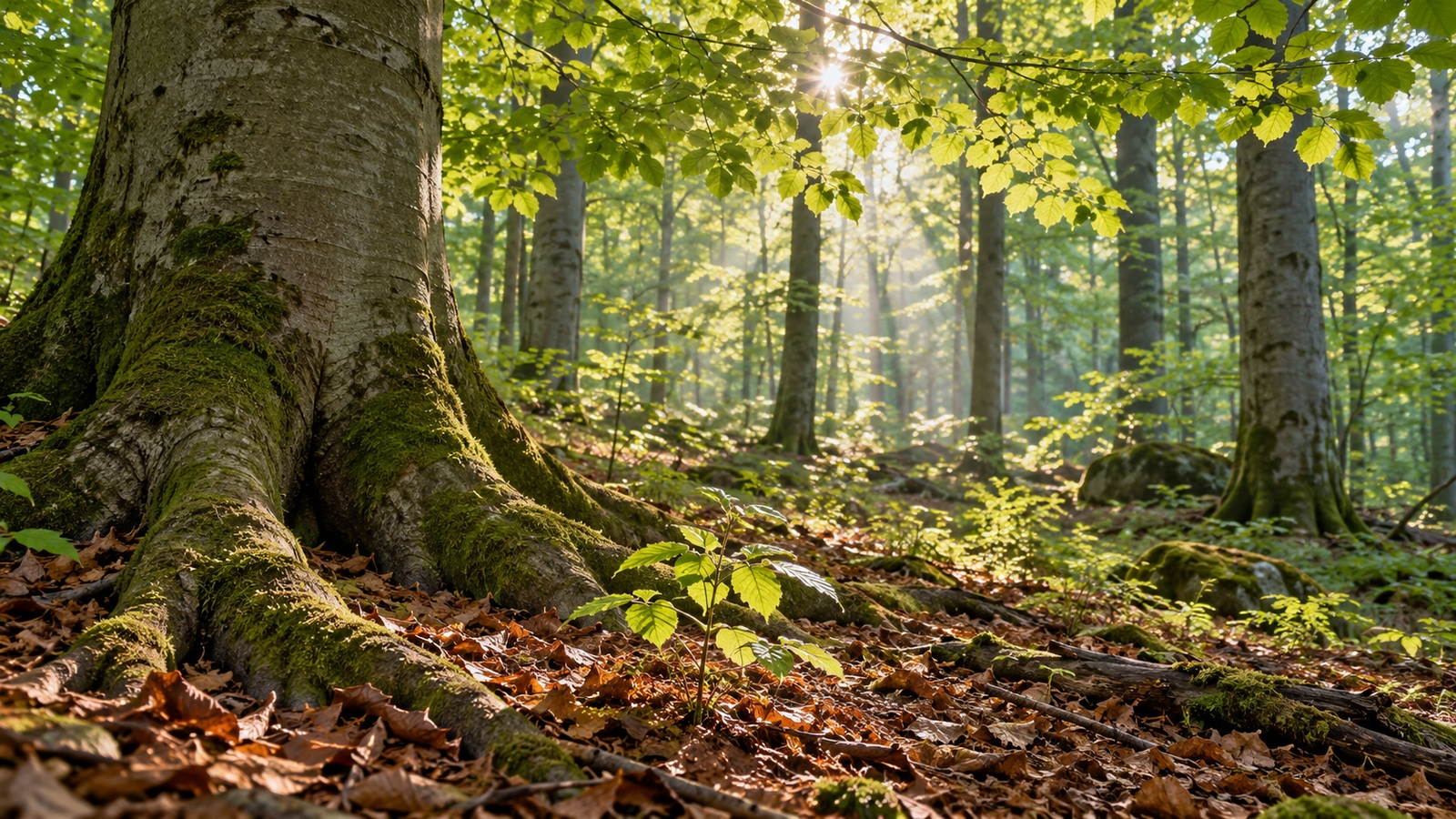
A forest’s store extends beyond its living stems. Roots, branches, bark, understory vegetation, fallen leaves, and logs contain carbon too, with litter and soil organic matter forming additional pools. Fine roots can introduce material directly into the ground, while a branch falling from above adds to the forest floor. The distribution changes as tissues grow and die. A stand with large trees but little dead wood has a different allocation from one carrying many old logs, even if the two canopies look similar from a distance.
A fallen tree makes the distinction easy to picture. Its carbon has moved from living biomass into dead material, but much remains inside the forest. Researchers estimate logs using dimensions, density, and decay condition; heavily decomposed wood cannot be treated like a newly fallen sound trunk. Litter is usually handled separately under stated size or material definitions. As decomposition proceeds, some carbon returns to the air and some enters soil pathways.
The mountain-ash study’s large living-plus-dead biomass estimate reflects both growing trees and material left by earlier generations. A substantial fallen trunk can remain while seedlings establish nearby, allowing different ages of material to coexist within one hectare. As a log decays, its density changes and its shape becomes less distinct. Some of its carbon is released, while some is transformed and enters soil pathways. The forest’s total is therefore distributed across living growth, recognizable dead wood, and less visible organic matter. Those parts continue changing even where the woodland boundary stays in the same place.
Maps extend field observations without eliminating their limits
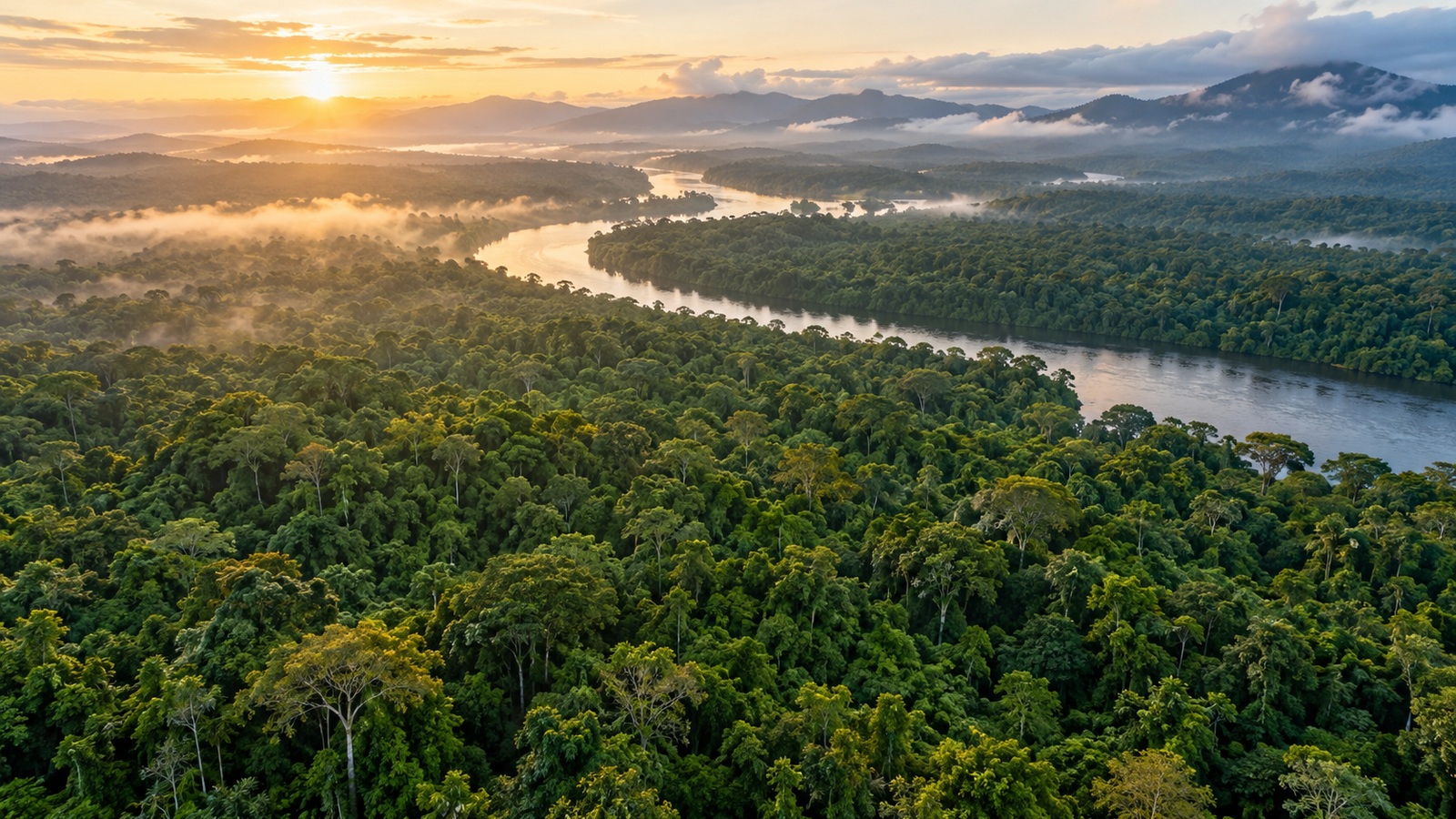
Airborne and satellite instruments extend forest observation across areas much larger than field crews can visit in detail. They detect features such as canopy height and structure, which researchers combine with plot measurements to estimate biomass. NASA’s explanation of three-dimensional forest mapping describes this connection between a canopy’s form and the material it contains. Tall, structurally complex stands can differ from short, open vegetation even where both cover the ground. The instruments do not directly weigh deep soil carbon, so underground pools need additional information. Mapping also shows the patchwork of growth and disturbance: a canopy gap, a regenerating area, and a mature stand occupy different places within the wider store.
A stock is not an annual removal rate
A forest holding a given quantity of carbon does not remove that entire quantity from the atmosphere every year. Stock is an accumulated amount; annual change is a rate determined by gains, losses, and transfers during an interval. Repeated inventories can estimate stock change if methods and boundaries remain comparable. Dividing an existing stock by the forest’s age gives a historical average under simplifying assumptions, not a reliable prediction of next year’s uptake. Growth and disturbance histories are rarely uniform enough to justify that shortcut.
Future accumulation depends on how the living forest develops. Small trees may grow rapidly relative to their existing size, while larger trees contain material built across many seasons. Water, nutrients, light, competition, and damage influence the next increment of growth. Meanwhile, older leaves, roots, and wood continue decomposing. A forest’s additional storage is the balance of those gains and losses, not a fixed empty space waiting to be filled. Fire, clearing, or severe drought can alter the trajectory again. The amount already present and the amount added next year consequently remain separate features of the ecosystem.
Large stores reflect many years of growth and survival
A large store is the result of carbon entering and remaining in an ecosystem through repeated seasons. Trees contribute new wood, roots supply the soil, and some dead material persists while further growth occurs above it. In a forest that avoids major losses for a long period, several generations of material can accumulate together. The store is not motionless: decomposers continue processing old inputs while plants supply new ones. Its persistence depends on how those flows balance under the site’s conditions.
Clearing a carbon-rich forest can interrupt that continuity quickly. Some material may burn, some may leave in harvested wood, and roots and other remains can decay after the canopy is gone. Regeneration begins with much smaller plants, which need time to rebuild woody structures. Soil recovery follows its own course and may not match the pace visible in the canopy. Protecting an established store therefore preserves material that new planting cannot reproduce immediately, even where growing conditions favor a vigorous young stand.
The amount a forest can store ranges widely because forests differ in structure, soils, history, and the conditions supporting growth and decay. The FAO average provides a global scale, while the old mountain-ash stands show how large a particular biomass store can become. Within any woodland, living trees are only part of the quantity. Dead wood, litter, roots, and soil connect today’s forest with earlier growth. Maintaining those connected stores keeps carbon retained while the living ecosystem continues developing.