Life at sea reaches far beyond the shoreline
A wave arriving at the coast carries the influence of a much larger world. The water has exchanged heat and gases with the atmosphere, transported nutrients, and passed through habitats shaped by living organisms. Beneath the surface, microscopic producers help support food webs that reach fish, seabirds, and marine mammals. Along the margins, wetlands, seagrass meadows, and other habitats connect young animals to the places they will use later. People depend on these relationships for food, livelihoods, coastal protection, and cultural continuity, even when they live far inland. The ocean’s importance comes from these linked physical and biological processes, rather than from one remarkable species or a single service. Understanding the connections reveals how marine ecosystems help sustain a habitable planet—and why protecting isolated patches without considering the surrounding system can leave essential relationships exposed.
A: Rising water supplies nutrients to sunlit plankton; production then moves through grazers and prey to larger fish, seabirds, and marine mammals.
A: No. Respiration and decomposition consume much of it within the broader cycle.
A: No. Water properties and circulation are central physical mechanisms.
A: No. Decomposition and circulation determine its subsequent path and residence time.
A: Some animals depend on estuarine habitat during their early life stages.
A: No. Protective effects depend on the setting and the event.
A: Species, feed, density, location, and management produce different outcomes.
A: Material transport and circulation connect many deep communities with processes above.
A: Governance and access determine how ecological benefits support people.
A: No. Reducing greenhouse-gas emissions remains necessary alongside local stewardship.
The California Current connects deep nutrients with life near the surface
Along western North America, the California Current ecosystem provides a visible example of ocean productivity. Winds can move surface water away from the coast, allowing colder water from below to rise in its place. That upwelled water carries nutrients into the sunlit layer, where phytoplankton can use them. A process beginning with wind and water movement consequently helps feed a living community.
The NOAA regional ecosystem account connects this seasonal production with krill, squid, sardines, and the larger fish, seabirds, and marine mammals that eat them. These animals do not all consume the same plankton directly. Food moves through grazers and prey, branching into a web with several routes. The abundance of a feeding animal can therefore reflect events far below its place in that web.
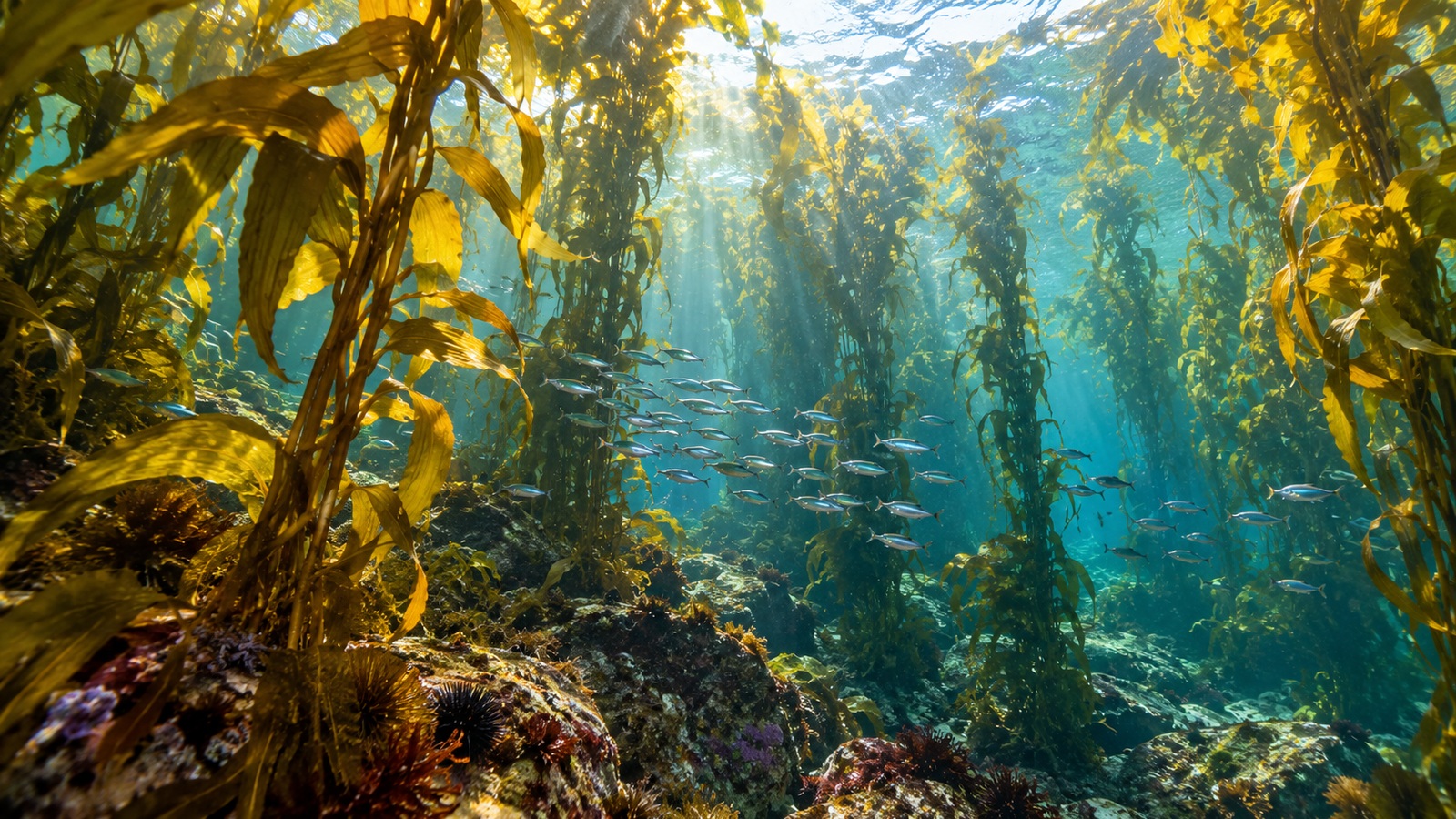
This mechanism explains why productive water need not look like a forest. Microscopic cells can multiply, be eaten, and be replaced rapidly without forming a large standing structure. Their repeated growth supports consumers that gather much more visibly at the surface. When a grazer consumes a cell, some material becomes its own tissue, while respiration and waste return other components to the surroundings. Recycling supplies further opportunities for growth, linking a short-lived cell to a much longer-lived community. Seagrasses and kelps add other productive settings, providing physical habitat as well as organic material. A kelp frond and a drifting plankton cell contribute through different structures and lifetimes.
The timing of upwelling affects which animals can use the resulting food. A pulse of plankton may coincide with abundant grazers or with young fish needing prey, while changing winds can move the productive water elsewhere. Nutrients also support different kinds of organisms: some blooms include harmful species, and excessive nutrient loading near land can lead to oxygen depletion when the organic material decays. Growth, feeding, and decomposition therefore operate as a connected sequence. The life supported by upwelling depends on the organisms present and the paths water takes through their habitats.
Marine photosynthesis contributes oxygen within a larger cycle
Ocean photosynthesizers release oxygen as they build organic compounds using light. Respiration and decomposition consume oxygen as organisms use those compounds, both near the surface and farther down the water column. The ocean oxygen cycle described by NOAA therefore includes continual production and consumption rather than one-way delivery from plankton to the atmosphere. The air people breathe draws on a large reservoir shaped over long periods. At sea, local oxygen conditions depend on the balance between supply, exchange, and use. A productive surface can support a rich food web while decomposition below consumes oxygen from deeper water. Circulation and mixing help connect those layers, giving marine life access to a changing combination of food and dissolved gases.
The ocean absorbs and redistributes heat
Water takes up large amounts of energy, and ocean circulation moves that heat between regions and depths. These physical processes influence winds, rainfall, and temperatures experienced far from the coast. Living organisms occupy the resulting environment, with growth, breeding, and movement tied to its seasonal patterns. A change in a current can alter which water reaches a feeding ground, while heat carried below the surface can persist beyond a short spell of cooler weather. Marine ecosystems are therefore part of a moving physical system whose influence reaches well inland.
Heat uptake also carries costs. Warmer water can alter habitat suitability, strengthen stratification, and contribute to thermal expansion and sea-level rise. Absorbing additional heat does not mean the ocean disposes of it harmlessly. The stored energy can affect marine life and coastal communities, while circulation determines where effects appear. This is one reason ocean protection and greenhouse-gas mitigation address different parts of the problem. Local habitat stewardship can improve resilience, but it cannot by itself remove the heat accumulating throughout the climate system.
Carbon travels through both chemistry and food webs
Carbon dioxide exchanges across the sea surface and enters reactions within seawater. Temperature, circulation, and the difference between carbon dioxide conditions in air and surface water influence that exchange. Much ocean carbon remains in dissolved inorganic forms, including bicarbonate, rather than becoming part of a fish or a coastal plant. Living organisms add other routes as they grow, feed, and respire. The ocean’s carbon role therefore extends across its water chemistry and biological activity, with visible coastal habitats forming one important part of a much larger store.
Biology creates additional movement. Photosynthetic organisms incorporate carbon into organic compounds, and feeding, respiration, and decomposition redistribute it. Some particles sink below surface waters, transferring carbon to depths where return to the atmosphere may be delayed. Not all production is exported, and not all exported material stays isolated for the same duration. The depth reached and the circulation pathways involved influence the outcome. The biological pump is therefore a set of processes with varying efficiencies and timescales, rather than a conveyor that permanently stores every particle.
Seagrasses, salt marshes, and mangroves retain carbon in living tissue and sediments. Leaves, roots, and other organic material enter soils where water conditions can slow further breakdown. The amount and duration of storage differ with sediment supply, vegetation, drainage, and disturbance. Exposing or eroding a deposit can change the conditions that previously retained its carbon. Conserving the habitat also preserves feeding and shelter opportunities, so its carbon function remains connected with a wider coastal community.
A nursery is one stage in a longer marine life
An estuary can provide shelter and feeding opportunities for young animals before they enter more exposed waters. Its shallows, vegetation, and tidal channels offer a different environment from an adult’s offshore feeding ground. As an animal grows, the balance between shelter, available prey, and the space it can use changes. Other species begin as drifting eggs or larvae carried between suitable habitats by currents. A population therefore depends on the sequence that lets these stages succeed, rather than only on the location where people see the largest adults. Damage to a nursery can appear later as fewer animals elsewhere; an offshore reserve cannot repair that missing early habitat on its own. Protecting a coast means tracing these connections through water quality, access, and the habitats used along the way. This perspective also explains why adjacent protected areas and ordinary working coastlines cannot be managed as completely separate worlds.
Living shorelines influence what waves encounter
Coastal wetlands, reefs, and other structured habitats can reduce wave energy under appropriate conditions. Vegetation slows water and can help retain sediments, while reef structures influence how waves break and move toward shore. The effect depends on habitat width, elevation, condition, storm characteristics, and local geography. No ecosystem creates an absolute shield against every storm or every level of flooding. Its protective contribution needs to be evaluated within the broader coastal setting, including the people and infrastructure behind it.
These systems also need room and suitable conditions to persist. A wetland squeezed between rising water and fixed development may be unable to shift inland. Pollution or physical damage can reduce the structure that provides both habitat and protective effects. Restoration therefore involves more than planting vegetation at the water’s edge. Sediment supply, hydrology, space, and long-term maintenance influence whether the living shoreline can continue functioning as conditions change.
Food security depends on functioning ecosystems and fair access
Marine fisheries connect ecological production with diets and employment. The amount that can be harvested sustainably depends on population dynamics, habitat, environmental conditions, and management. Healthy ecosystems support the processes through which fish grow and reproduce, but abundance alone does not determine who receives the benefit. Access rights, market arrangements, infrastructure, and governance affect whether coastal communities can turn marine resources into secure food and livelihoods. A strong ecological foundation needs fair and effective institutions to support human well-being.
Aquaculture adds another relationship with marine environments. Some forms cultivate animals or algae that rely on surrounding water conditions, while other systems require substantial feed and management inputs. Impacts differ by species, location, density, and operating practice. It is therefore inaccurate to treat all aquaculture as either a uniform solution or a uniform problem. Water quality, disease management, feed sourcing, and interactions with surrounding habitats help determine the result.
Culture and identity also belong in this account. Fishing practices, navigation knowledge, customary access, and relationships to particular species can connect communities to the sea across generations. Those values are not captured fully by the market price of a catch. Changes in access or ecological conditions can disrupt ways of life even when seafood remains available through distant markets. Ocean stewardship is consequently about the continuity of human relationships as well as the persistence of biological populations.
The deep sea participates even where sunlight disappears
Below the sunlit layer, many communities depend on organic material supplied from above, while some settings support food webs based on chemosynthesis. Microorganisms transform nutrients and carbon, animals move and consume material, and interactions with sediments influence longer-term cycling. The deep sea is not an empty space below the productive surface. Its slower processes, specialized organisms, and connections to circulation help shape the larger marine system. Disturbance can be difficult to monitor or reverse, especially where growth and recovery are slow. Understanding these environments requires acknowledging both their ecological importance and the substantial gaps that remain in observation. Distance from everyday experience does not make a habitat disconnected from the processes supporting life elsewhere.
Protecting relationships gives conservation a wider purpose
A marine protected area reduces the pressures controlled within it, but water and animals continue crossing its boundaries. Larvae can drift out toward another habitat, a mobile predator can feed beyond the reserve, and pollution can arrive from land or neighboring water. Protection therefore works alongside fisheries rules, clean-water measures, and coastal planning. Keeping a nursery intact supports young animals only if later life stages can also find suitable conditions. Conservation across connected habitats helps those successive stages continue, rather than leaving a protected patch surrounded by pressures that undermine its living community.
Oceans are essential because physical and living systems operate together across scales, from a microscopic cell to a planetary current. Their benefits reach people through food, climate regulation, protection, knowledge, and cultural life. Preserving those benefits requires more than celebrating ocean vastness. It means maintaining habitat connections, reducing damaging pressures, respecting community rights, and limiting the warming that changes the environment itself. The shoreline is simply the place where many of these connections become visible; their importance extends across the planet.