A reef is a neighborhood built by living animals
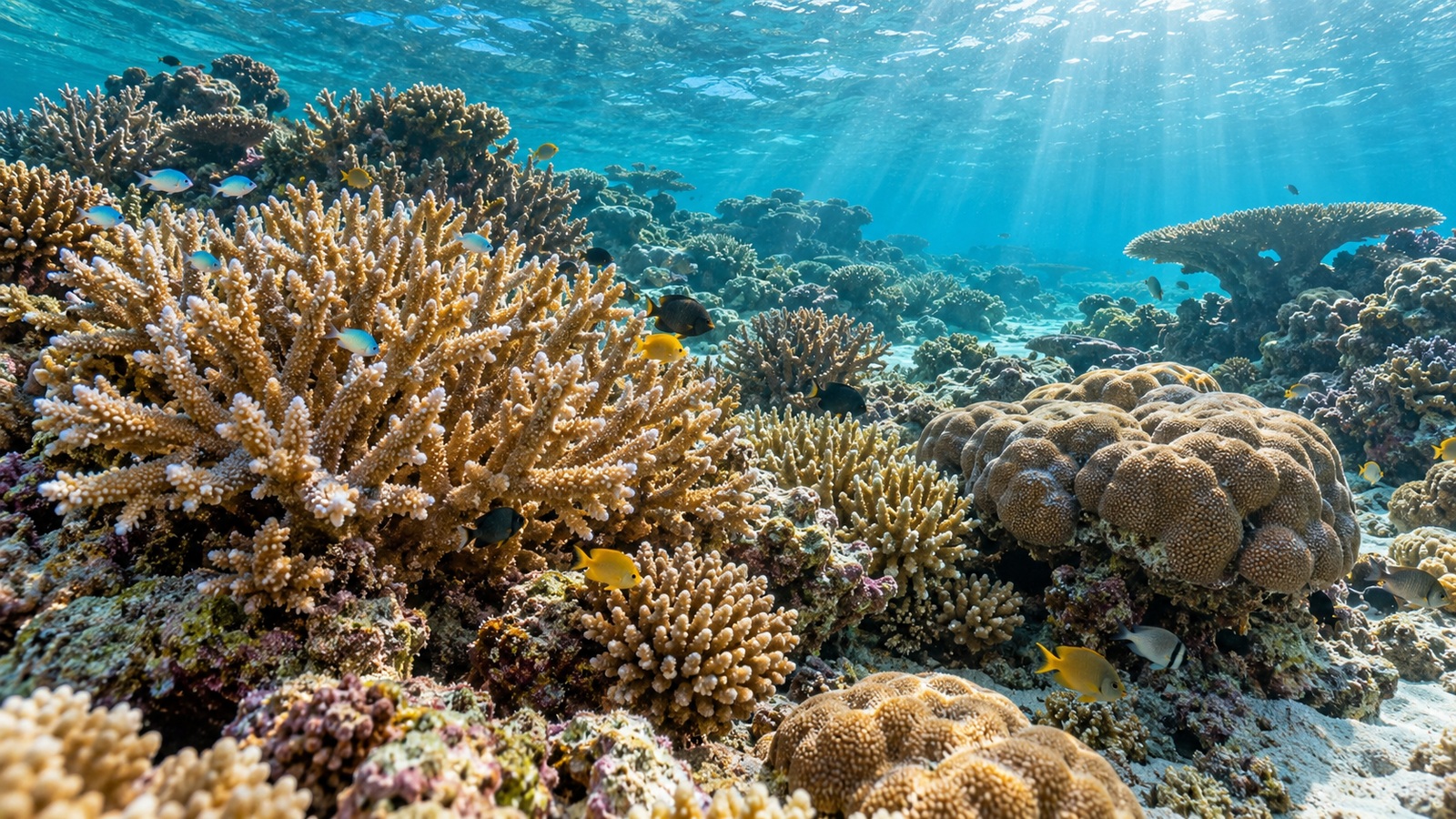
A coral reef can resemble a stone garden, but its builders are animals. Small polyps produce skeletons that accumulate into structures used by a remarkable variety of other organisms. Fish shelter among branches, tiny animals occupy crevices, and grazers work across surfaces where algae compete for room. The resulting community depends on much more than colorful coral cover. Sunlight, water movement, food, chemistry, and relationships between species help determine whether the structure grows or wears away. Nearby habitats can support animals that use the reef during only part of their lives. Following those relationships explains why reefs matter so much to marine life and to coastal communities. It also clarifies why a reef can lose important functions before every coral disappears, and why recovery involves rebuilding an ecological community rather than merely attaching new fragments to rock.
A: They are animals; many host photosynthetic algae.
A: No. Coral habitats and growth strategies vary widely.
A: Their spaces provide shelter at several sizes.
A: Recovery is possible if stress eases sufficiently.
A: Remaining skeletal shelters can erode and collapse.
A: Their feeding methods remove algae in different ways, so the ecological work depends on which fishes are present.
A: Yes, where species depend on those connected habitats.
A: Protection varies with reef structure and event conditions.
A: Its smaller structure needs time to grow before it recreates the larger branches, crevices, and refuge spaces used by reef animals.
A: Land pollution and greenhouse-gas emissions cross local boundaries.
The builders are colonies of small polyps
A coral polyp has a mouth surrounded by tentacles and belongs to the same broad animal group as sea anemones and jellyfish. In many reef-building species, numerous connected polyps form a colony. They deposit calcium-carbonate skeleton beneath and around their living tissues, adding to structures that can outlast individual polyps. Colony shapes differ greatly: branching, massive, encrusting, and plate-like forms create different spaces and respond differently to waves and other disturbances. The shape of the community therefore influences the habitat available to its residents.
Corals also live outside shallow tropical reefs. Deep and cold waters support species with different growth forms and feeding conditions, including corals without the light-dependent partnership familiar from tropical reefs. Even a shallow reef contains contrasting environments: an exposed crest receives waves and strong light, while a deeper slope has different water movement and illumination. Species occupy those settings in different combinations. A coral suited to one depth or exposure may not thrive in another, so the community changes across the reef rather than repeating the same colony from shore to deep water.
Algal partners help sustain many shallow-water corals
Many tropical reef-building corals host microscopic photosynthetic algae within their tissues. The algae supply organic compounds made using sunlight, while the coral provides shelter and resources associated with its metabolism. This mutualistic partnership helps support growth in relatively nutrient-poor water. Heat stress can disrupt the relationship, causing a coral to lose many of the symbionts or their pigments. The pale appearance is called bleaching: the living animal is still present, but it has lost an important source of energy. Some colonies regain their partners when conditions improve, while sustained stress can lead to tissue death. Growth and reproduction can also remain impaired during recovery, and animals depending on the colony may experience changes in food or shelter before its skeleton breaks down.
Staghorn coral shows how a colony becomes habitat
Caribbean staghorn coral, Acropora cervicornis, makes the relationship between animal and architecture especially clear. Its branching colonies create a bush-like structure, with spaces between branches that other reef organisms can occupy. NOAA’s species account identifies this complex form as habitat for fish and other reef residents. A colony is therefore doing two jobs at once: maintaining its own living tissues and building the three-dimensional surroundings in which other animals live. Narrow spaces can admit small animals while restricting a larger predator’s approach. As colonies grow or break, the dimensions of those spaces change, altering the shelter available to residents of different sizes. Losing branches changes that neighborhood even when part of the colony survives.
A staghorn skeleton can remain standing after the tissue covering it dies. At first, fish may still shelter among the branches, but the dead structure no longer grows as a living colony does. Waves, borers, and other erosional processes gradually weaken and break it. The refuge becomes smaller or flatter, changing which animals can use it. New colonies begin on a much smaller scale and need time to build a comparable branching form. Living coral cover and physical shelter therefore change on different schedules: a reef can lose its builders before all the old architecture disappears.
Reef growth is a balance between building and erosion
A reef framework accumulates when biological construction and other additions keep pace with processes that remove material. Living corals are prominent builders, while other calcifying organisms can contribute or bind surfaces together. Waves break structures, chemical conditions affect carbonate minerals, and animals bore or scrape material. A reef is consequently not a static monument that simply gets larger whenever some coral remains alive. Its long-term form reflects the balance between these opposing processes.
Bioerosion is part of normal reef ecology. Organisms that graze or bore into the framework can create sediment, open surfaces, or make small spaces available to other life. The problem arises when losses persistently outpace building, leaving a flatter or weaker structure. Coral cover alone does not capture that balance. A patch with living colonies may still be losing its underlying framework, while a recently damaged structure may retain complexity for a time before physical breakdown becomes obvious.
A severe event can kill coral tissue quickly while the framework erodes more slowly. Fish may initially retain familiar hiding places, then lose them as weakened branches collapse. Young corals growing nearby begin to add new material, but their small colonies cannot immediately replace the spaces made by older structures. The community consequently passes through an interval in which the amount of shelter and the abundance of living builders are changing differently. Recovery takes both continued coral survival and enough growth to rebuild the framework other organisms use.
Architecture creates many ways to share limited space
Reef complexity offers surfaces and shelters at different scales. A narrow hole may protect a small animal while excluding a larger predator; an overhang may provide shade or a resting location. Water flow around the structure delivers food to some residents and creates different conditions in sheltered pockets. These variations allow organisms with different requirements to occupy the same general area. Complexity does not guarantee that every species benefits equally, but it helps explain how a relatively small footprint can support many ecological roles. When the structure flattens, habitat opportunities change even if the site remains covered by seawater and some algae. Protecting reef biodiversity therefore includes preserving the three-dimensional spaces on which animals depend, rather than measuring only the outline of the reef on a map.
Parrotfish and surgeonfish graze in different ways
Algae grow across reef surfaces, sometimes occupying space that young corals need. Parrotfish can scrape algae with strong beak-like teeth, removing some underlying material in the process. Surgeonfish graze differently, cropping upper parts of algal growth. NOAA’s account of grazer research explains why body size, diet, and feeding method change the contribution of different fishes. Counting all algae-eating fish as interchangeable would miss those differences in the surfaces they reach and the amount removed with a bite.
Grazing is one route through a much larger food web. Predators consume reef animals, scavengers use remains, and microbes break organic material into forms that can cycle again. Corals also capture food with their tentacles. Nutrients arriving from land can shift the balance toward excess algal growth, while loss of grazers changes the removal side. Following these transfers explains how the same physical reef can support different communities as the abundance and behavior of its residents change.
A reef’s residents may depend on places beyond it
A reef can be one stop in an animal’s life rather than its only home. Some young reef-associated fish use seagrass meadows, mangroves, or other sheltered coastal habitats before moving into different feeding grounds. Larvae can drift on currents and settle on a reef far from the colonies that produced them. These routes connect the community with water and habitats beyond the visible coral. A damaged nursery can reduce later arrivals, while poor conditions at a source reef can change the larvae reaching another site. Species differ in the connections they use, and some do not follow these routes at all. Where a pathway matters, keeping its successive habitats intact supports the animal through growth, movement, and reproduction. A protected reef can therefore depend on neighboring coasts that look very different from the colonies sheltering its adults.
Coastal communities receive benefits from functioning reefs
Reef fisheries support food and livelihoods where harvest remains compatible with population renewal and habitat condition. Tourism can create income and opportunities for education, though poorly managed visitation can also cause damage or distribute benefits unequally. The value to a community depends on access, management, and the strength of local institutions as well as ecological abundance. A reef can be biologically important while the people closest to it receive little of the revenue associated with outside visitors.
Reef structures can also dissipate wave energy before waves reach the shore. Their contribution depends on depth, shape, roughness, location, and the characteristics of the incoming water. They do not eliminate every flood or storm risk. Continued erosion or loss of relief can change the protection they provide, connecting ecological condition with coastal planning. Building on the assumption that a reef offers a permanent, unchanging barrier can therefore produce misleading expectations about future exposure.
Cultural relationships add another dimension. Reefs may be associated with customary fishing grounds, knowledge, identity, and responsibilities transmitted between generations. Those values cannot be fully represented by visitor spending or the market price of fish. Stewardship is more durable when it respects the communities holding these relationships and includes them in decisions. Ecological restoration alone cannot resolve disputes about access or replace the institutions needed to sustain fair use.
Recovery needs recruitment, survival, and a workable environment
New coral life begins when larvae settle on suitable surfaces and survive long enough to grow. Existing colonies can also recover living tissue or extend their structures after damage. Grazing affects how much algal cover occupies potential settlement space, while water quality, disease, and later heat episodes influence survival. A young recruit has little of the shelter provided by a large colony, so its value to the surrounding community changes as it grows. Repeated disturbance can interrupt that development before the reef’s former structure returns.
Coral nurseries raise living material that can be placed at restoration sites, helping rebuild particular populations or damaged patches. The outplanted colonies still need suitable light, water conditions, and room to grow. They face the same local pollution and wider climate pressures as nearby corals, while their reproduction and survival help determine whether a continuing population develops. A restoration effort can add living builders without immediately recreating the former reef. The surrounding food web, grazing community, and habitat connections remain part of the environment in which those builders must persist.
Reef protection works from the watershed to the atmosphere
Reducing sediment and pollution from land can improve local conditions, while appropriate fishing and visitor management can reduce direct damage and support ecological relationships. Addressing greenhouse-gas emissions is essential to limiting the wider changes that challenge reef survival. These actions operate at different scales and reinforce one another. Local stewardship has value even when it cannot solve global warming, and global mitigation does not excuse neglect of a reef’s immediate surroundings. The goal is to preserve the conditions under which living builders, their partners, and their many neighbors can continue creating habitat. Reefs are essential to ocean life because they organize space, resources, and relationships over time. Protecting that living architecture requires attention to the whole community and to the pressures shaping its future.