Arctic change connects the ocean, the ground, and daily life
The Arctic is changing through several linked pathways. Less persistent sea ice alters the ocean surface and the habitat available to wildlife. Warmer ground can change drainage and weaken the foundations beneath buildings, roads, and other infrastructure. Seasonal shifts influence vegetation, food webs, and the conditions people encounter while traveling or harvesting. These transformations do not occur at one uniform pace, and a cold winter or a locally favorable season does not describe the longer regional trend. Nor is the Arctic an empty expanse whose importance lies only in what happens elsewhere. It is home to diverse ecosystems and communities with deep relationships to particular places. Understanding its transformation requires following how physical changes interact with living systems and human decisions, while recognizing the differences between regions, seasons, and the evidence used to describe them.
A: The 2022 Rantanen study compared 1979–2021 temperature trends for the region north of 66.5 degrees with the global average.
A: Thickness, timing, snow, and ice structure also matter.
A: More open water can allow greater wave exposure.
A: Drainage changes can produce wetting or drying.
A: The active layer already thaws seasonally above much permafrost.
A: Nutrient supply and community composition can limit outcomes.
A: Grounded ice loss and ocean expansion are different major pathways.
A: Communities need usable conditions during particular activities and seasons.
A: No; cold spells and local variability continue within a climate whose long-term regional temperature has risen rapidly.
A: Adaptation addresses consequences while mitigation limits the driving warming.
The Arctic warmed nearly four times as fast as the globe in a 1979–2021 study
A 2022 study by Mika Rantanen and colleagues found that the region north of 66.5 degrees warmed nearly four times as fast as the globe during 1979–2021. This amplified warming developed across a period that still included cold seasons and strong local variation. The contrast is between long-term regional and global trends. Places within the Arctic continued to experience different winds, ice conditions, and seasonal responses while contributing to that regional change.
Bright snow and ice reflect sunlight, while darker exposed land and water absorb more energy when the sun is present. After summer, water can release some stored heat into the atmosphere, linking conditions across seasons. Clouds, moisture, atmospheric structure, and heat transported from elsewhere contribute additional influences. These relationships reinforce or reshape the regional response rather than warming every location equally each day. A coast can have an unusually cold spell within a much warmer long-term climate, while nearby ocean conditions carry the effects of earlier seasons. The resulting amplification reaches living organisms through the ice, ground, and water they use.
Sea-ice change alters both a surface and a seasonal habitat
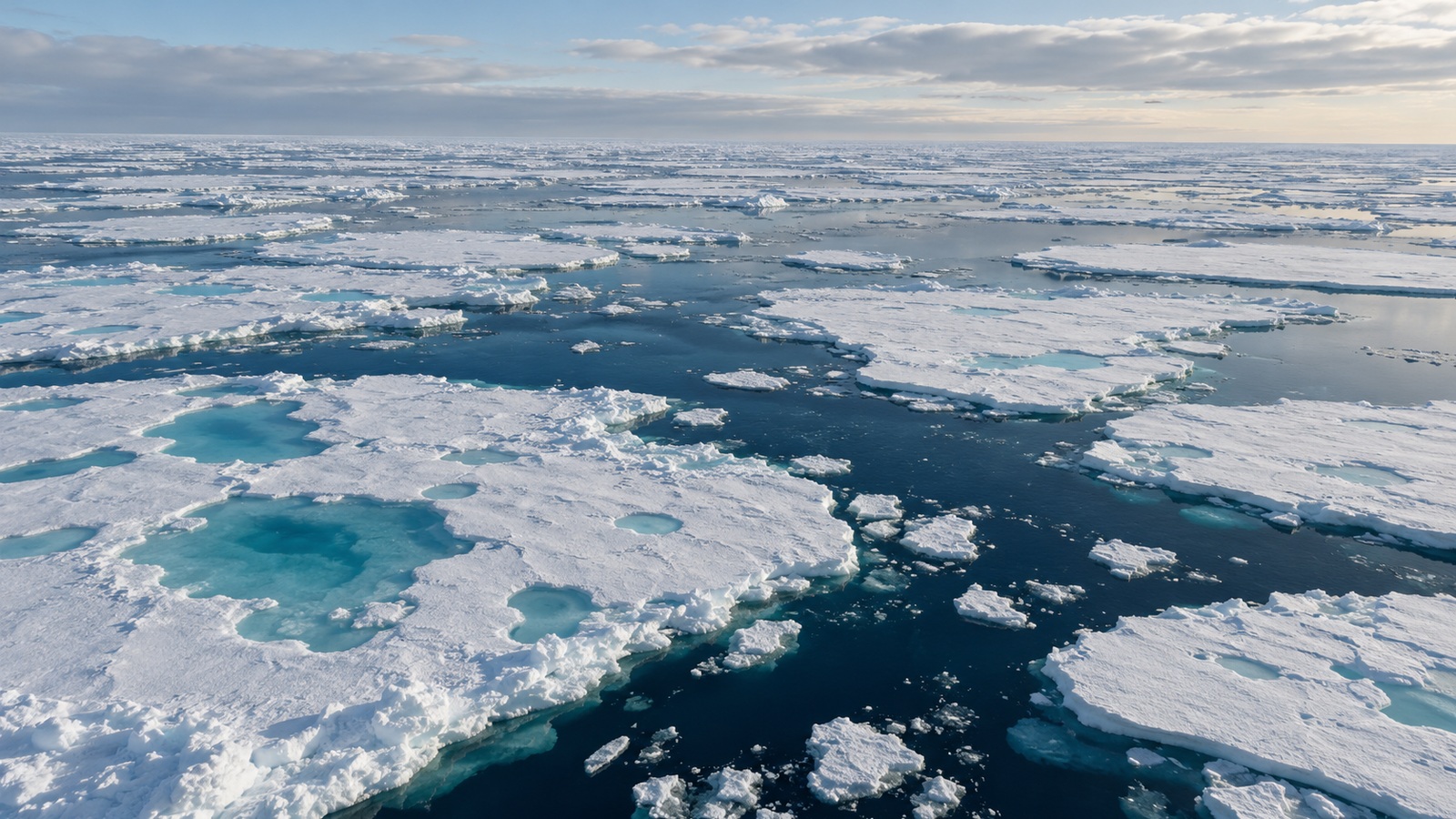
Sea ice forms from ocean water and changes through freezing, melting, movement, and deformation. Newly formed thin ice behaves differently from thicker cover that has survived earlier seasons. Snow changes insulation and the light reaching the water, while leads and other openings create routes between the ice and ocean. Animals encounter those details through feeding, resting, or breeding, and travelers encounter them through access to particular places. Earlier retreat can shorten the time a platform remains usable, while later formation delays the start of an ice season. The habitat is therefore a changing surface through the year, with location, structure, and timing shaping which activities it can support.
A more exposed ocean changes coastal conditions
Open water allows wind to generate waves where ice previously limited that process. In suitable coastal settings, a longer open-water season can increase exposure to erosion, especially when storms coincide with vulnerable shores. Coastal ground composition, sea level, protective features, and local weather all influence the outcome. The relationship is therefore more specific than saying that less ice produces identical erosion everywhere. Ice conditions alter the setting in which storms act, while the coast’s own characteristics help determine the damage.
Communities can experience the result through threatened infrastructure, changing access, and loss of culturally important places. Protecting one structure may be feasible while a broader settlement faces more difficult choices. Decisions about protection, relocation, maintenance, or changes in use involve costs, rights, and community priorities. Physical projections inform those choices but do not determine them by themselves. Meaningful participation is essential because the consequences extend beyond property to relationships with land, water, and community life.
Permafrost thaw reorganizes landscapes from below
Permafrost is ground that remains at or below freezing for at least two consecutive years. It may contain considerable ground ice, but the amount varies. When ice-rich ground thaws, the surface can subside or become unstable, changing slopes, drainage, and the support available to structures. A seasonally thawed active layer already exists above much permafrost, so change needs to be assessed against the normal seasonal pattern. The relevant concern is not simply that the surface becomes unfrozen during summer.
Ground containing substantial ice can change shape when that ice melts. A depression may collect water, while another location drains more freely after its terrain or subsurface connections change. Vegetation then encounters a different moisture pattern, and water carries dissolved material along new routes. Roads and buildings can lose support as the ground settles unevenly. The outcome depends on the material beneath the surface as well as on warming: two nearby sites can respond differently because their ground ice, soils, slopes, and water pathways differ.
Thaw exposes some formerly frozen organic matter to microbial activity. In oxygen-rich conditions, decomposition can release carbon dioxide; wetter, oxygen-poor settings can support pathways producing methane. Plants also take up carbon as they grow, while fire and erosion alter stores in other ways. The landscape’s greenhouse-gas balance develops through those combined processes. Frozen carbon does not all leave at once when thaw begins: the amount released and its timing depend on the condition of the material, water, temperature, and the organisms able to use it.
Snow and vegetation changes reshape the land’s seasonal rhythm
Snow influences insulation, surface reflectivity, water supply, and access to food beneath it. Changes in depth, persistence, and the occurrence of rain on snow can therefore affect organisms differently from a simple rise in average air temperature. Ice layers formed within snow can make forage difficult to reach for some herbivores. Earlier snowmelt can create opportunities for plants while changing exposure to later cold or dry conditions. A longer nominal growing season is not automatically a proportionately larger gain in plant production. Moisture, nutrients, disturbance, and species composition determine what happens. Vegetation changes can then alter shade, snow trapping, and habitat, feeding back into the physical conditions that influenced growth in the first place.
Marine food webs respond to changes in light and water
Sea-ice retreat can change the amount and timing of light reaching water, but plankton also need nutrients and suitable physical conditions. Increased light does not guarantee unlimited production. Mixing, stratification, inflows, and the distribution of nutrients can alter which organisms grow and when consumers can use them. Changes in ice-associated production and open-water production can rearrange the seasonal food supply rather than simply adding more food to the same system.
Fish, seabirds, and marine mammals encounter changing prey through feeding, movement, and reproduction. A food pulse arriving earlier or farther from a breeding site can be harder to use even when production increases elsewhere. Species entering from lower latitudes can add predators or competitors to the community. Established Arctic residents then face a different collection of interactions alongside the changed temperature. Small plankton and grazers remain central because their growth and timing help determine what reaches the larger animals, linking seasonal water conditions with survival and the next generation.
A changing travel season can affect access and safety
Ice and snow connect some northern communities with harvesting areas, neighboring settlements, and seasonal activities. Later freeze-up or earlier breakup changes when a familiar route is available. Thin or moving cover can interrupt a journey even while ice remains nearby, and longer open-water periods bring different vessel, weather, and equipment needs. Those changes affect access rather than simply the distance between two places. Community observations connect current conditions with practical experience of the coast and its seasons. Money, transport, and time also influence which alternatives a household can use. The same physical change can therefore create a new option for one activity while making another harder to sustain.
Regional changes connect with wider climate and ocean systems
Arctic snow and ice influence how much sunlight the region absorbs, while freshwater and carbon move into the wider ocean and atmosphere. Greenland’s grounded ice adds water to the ocean when it loses mass, contributing to sea-level rise. Floating sea ice already displaces water, so its direct melting has a much smaller sea-level effect. Its retreat instead changes the ocean surface, habitat, and exchange of heat. Land ice and sea ice thus connect the region with the rest of the planet through different physical routes, even when both appear as white surfaces on a map.
The atmosphere and ocean also move heat between the Arctic and lower latitudes. Winds and circulation affect northern conditions, while the changing northern surface can interact with wider atmospheric patterns. The strength of those interactions differs with season and the situation involved. Weather farther south also responds to other influences, so a cold spell is not the product of one Arctic mechanism alone. The region remains connected to global climate through those exchanges as well as through its reflectivity, land-ice loss, and changing carbon stores.
Coastal ice change reaches the shores of Utqiaġvik
On Alaska’s Arctic coast, Utqiaġvik experiences sea ice as a local moving environment. The University of Alaska Fairbanks maintains coastal radar and webcam observations that follow changing ice patterns and seasonal events. Formation of stable cover, spring melt, and breakup take place beside the shore where people travel and use marine resources. Conditions there can differ from the wider ocean, because wind, currents, grounded features, and nearby ice movement shape the coastal setting. A season’s change is consequently experienced through particular openings, routes, and stretches of coast.
For people using that ice, presence and usability are different conditions. A continuous-looking area can contain thin cover or moving parts, and a familiar route can become unavailable at the time of a planned activity. Coastal observations support an understanding of those changes alongside local experience; they do not make any route automatically safe. Decisions remain tied to the conditions people encounter and the purposes of their journeys. Knowledge, rights, and responsibilities are part of that relationship, connecting environmental change with food access, travel, and community life rather than with an abstract ice total alone.
On land, thaw creates a different set of practical consequences. A road may need repair where settlement changes its surface, while a building’s foundations may require a response suited to the ground beneath them. A shifted harvesting season can change equipment needs or the time available for obtaining food. Those tasks require resources as well as knowledge of the physical change. Maintaining access can involve combinations of engineering, transport arrangements, cooperation, and community decisions about priorities. Adaptation develops through those particular choices while the wider climate continues to influence the ice and ground on which they depend.
Reducing the drivers remains part of the Arctic response
Monitoring and adaptation can help people respond to change, but they cannot replace reductions in the emissions driving long-term warming. Local conservation can protect habitats or reduce disturbance while the physical environment continues shifting. These actions are complementary, and their benefits occur on different schedules. The Arctic’s transformation is best understood as a set of interacting changes in ice, water, ground, life, and human access. Maintaining that connected view helps identify useful interventions without promising that one project can restore every earlier condition. The region’s future will depend both on decisions made within it and on the scale of climate action far beyond its boundaries.