Small arrivals can leave an enormous ecological footprint
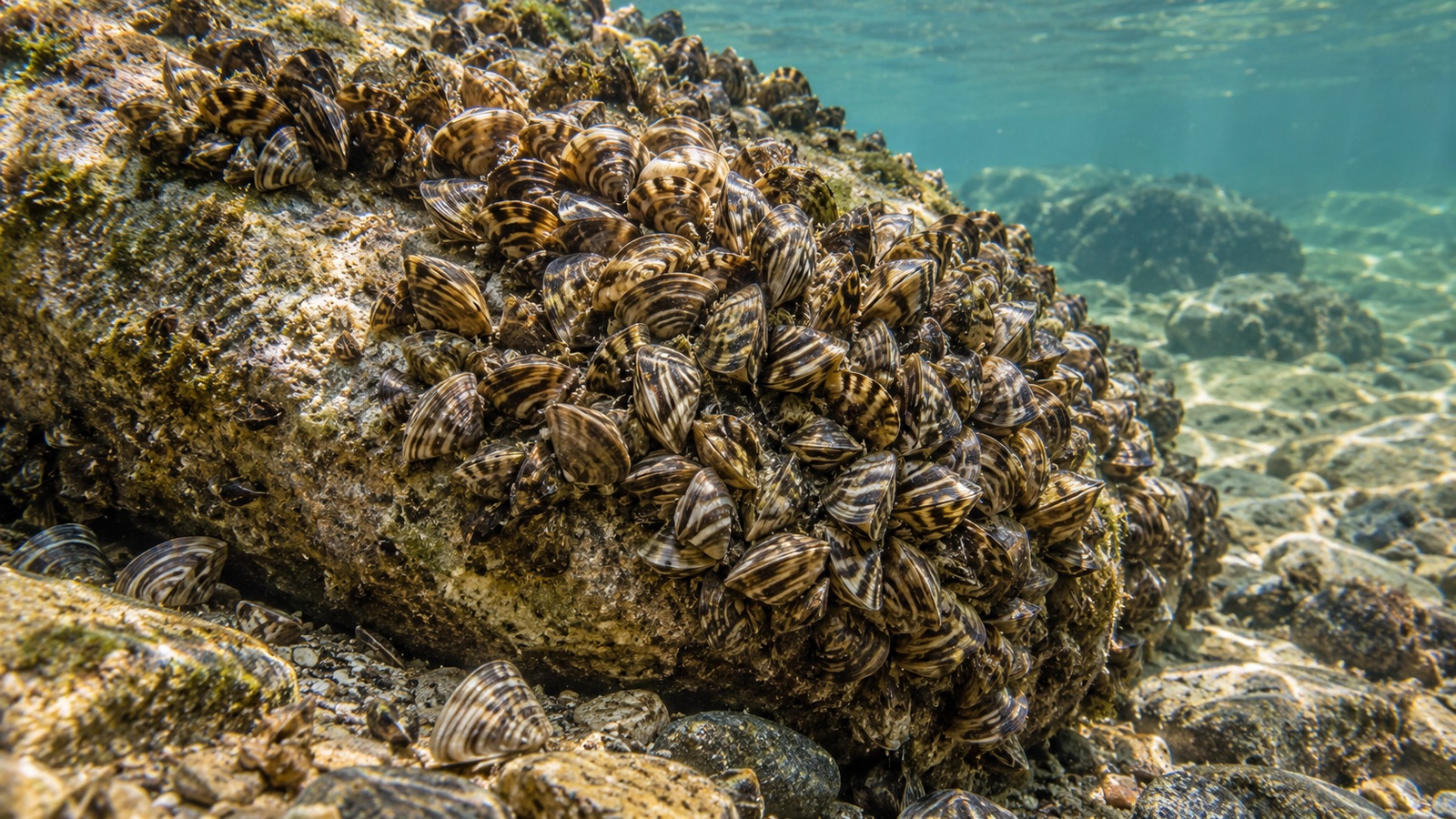
A rock covered in striped mussels may look like an unusually successful patch of aquatic life. In an invaded lake, those mussels can redirect food toward the bottom and burden native mussels with attached shells. On an island, a climbing snake can reach birds and their nests, while an introduced fungus can remove mature trees from a forest canopy. These contrasting invaders cause damage through different relationships with the communities they enter. Their effects can extend beyond the first animal killed or plant displaced, changing shelter, food supply, and reproduction for other organisms. The Great Lakes, Guam, and other affected places show how those changes develop. They also reveal why preventing transport can protect a community before damage begins, and why reducing an established invader may need to be followed by years of native recovery.
A: A receiving community can contain susceptible hosts or prey and fewer of the relationships that constrained the organism in its home range.
A: Introduced pathogens can transform ecosystems through disease rather than predation.
A: Receiving habitats and biological communities influence the specific outcome.
A: The Guam example concerns introduction outside their native distribution.
A: Consumption of seeds and other plant material can influence plant populations.
A: Surviving trees and sprouts remain despite major historical canopy losses.
A: Exposure and susceptibility differ among predators and locations.
A: It means removing the target population completely within the defined area.
A: Yes, when reduced pressure produces a documented benefit for the protected ecosystem.
A: A renewed arrival can undo the protection that removal achieved.
Damage develops in the receiving community
An organism introduced outside its natural range can enter a community that has little protection against its activities. Native prey may lack effective defenses, or a pathogen may encounter susceptible hosts across a large area. The same organism can occupy a different role in its home range, where predators, competitors, and other relationships constrain it. In a receiving ecosystem, repeated deaths or reproductive failures can reduce native populations. Habitat changes can then affect organisms that never encounter the invader directly, extending the consequences beyond the original interaction.
Island communities can be especially vulnerable because an affected population may have nowhere else to persist. A mainland species distributed across many habitats has more geographical separation from a local outbreak, although widespread transport can expose additional populations. Lakes present another pattern: organisms can spread within connected water and jump between separate waters with human activity. The area reached, the organisms exposed, and the continued arrival of new individuals influence how quickly damage grows and how much opportunity remains to limit it.
Zebra mussels changed resource pathways in the Great Lakes
Zebra mussels were discovered in Lake St. Clair in June 1988, as documented in Great Lakes research. They attach to surfaces and filter suspended particles from water. In invaded systems, dense populations can redirect food and nutrients toward the bottom, colonize native mussels, and obstruct water infrastructure. The USGS species profile explains the biology and impacts. A native mussel’s shell can itself become an attachment surface. An accumulating burden can interfere with the animal’s movement and feeding, while the attached mussels also use suspended food. The encounter therefore combines a physical obstruction with competition for resources, helping explain why the effect cannot be understood from water clarity alone. The receiving ecosystem matters: a species’ activity has a different consequence when it enters a community without that established relationship. Clearer water after intense filtering can look appealing while food availability and native animals change. The visible improvement in transparency does not tell the whole ecological story. Following where particles and nutrients go helps explain how a small attached mussel can influence a much larger lake community.
Guam's brown treesnake affected birds and the roles they performed
Brown treesnake predation devastated Guam’s birds after introduction. A 2003 study examined northern Guam surveys from 1976–1998 and reported local loss or serious reduction of most of the island’s twenty-five resident bird species. A climbing predator could reach birds in trees as well as animals nearer the ground. The island community had developed under a different set of pressures, leaving many birds vulnerable to the new source of mortality. Continued predation removed individuals faster than affected populations could replace them.
The flightless ko’ko’, or Guam rail, makes the loss more tangible. USGS’s current project account describes how brown treesnakes and other predators nearly eliminated it from Guam by the early 1980s. Different birds also disperse seeds, consume insects, and connect vegetation through their movements. Losing a bird community can therefore alter processes as well as remove familiar voices. An introduced replacement bird does not automatically recreate every missing function.
Keeping the snake from reaching another vulnerable island addresses the problem before those losses occur. Restoring birds where predation remains high faces a much harder task. The Guam history explains why inspection and transport safeguards matter alongside work in invaded habitat: they protect relationships that could take sustained effort to rebuild. The conservation objective is the persistence of the affected native community, with snake management one means of supporting it.
Introduced rats reach far beyond stored food
On islands, introduced rats can consume eggs, chicks, invertebrates, seeds, and other foods that connect them with many native species. New Zealand’s Department of Conservation describes these broad impacts and the differences among rat species. A small mammal can therefore exert pressure across several parts of an ecosystem without being its largest or most conspicuous animal. The particular consequences depend on the rat species, the island, and the organisms present.
After invasive rats are removed from an island, surviving native animals can encounter fewer losses at nests and feeding sites. A successful breeding season adds young that may later become breeders themselves, allowing gains to build over several generations. Plants can also benefit where fewer seeds and seedlings are consumed. Recovery still depends on remaining habitat and the organisms available to recolonize it. Boats and cargo can carry rats back, reconnecting the island to a pathway that removal had interrupted. Continued biosecurity protects the safer conditions under which native reproduction resumes, helping prevent a renewed population from undoing earlier gains. An island with several surviving native populations has more starting points for that recovery than a site where the affected organisms have already disappeared. Keeping the refuge secure preserves those living sources.
Chestnut blight illustrates damage without a visible animal invader
Chestnut blight, caused by an introduced fungus, transformed eastern North American forests by killing the aboveground portions of American chestnut trees. The National Park Service describes the historical impact and surviving trees and sprouts. Living roots can send up new shoots after a trunk dies, allowing an individual to persist without rebuilding a secure mature canopy. Repeated infection can interrupt growth before dependable reproduction returns. The forest consequently loses much of the structure and food supplied by large chestnuts while other vegetation occupies the space. Surviving sprouts preserve living material and possible recovery opportunities, but their small size supports different relationships from those of mature trees.
Cane toads can harm predators through toxic encounters
Cane toads in Australia illustrate a mechanism different from hunting native prey or infecting trees. Their toxins can kill susceptible predators that attempt to eat them. The Australian government’s cane toad overview explains why their introduction became a conservation concern. Risk is not distributed evenly among all Australian animals. Exposure, feeding behavior, and susceptibility affect which populations face the greatest pressure.
A vulnerable predator can encounter toads while following its ordinary feeding behavior. Exposure depends on where the animals overlap and whether the predator attacks or swallows the toad. A local reduction in toads may help a particular refuge, while a widespread established population continues spreading beyond it. Animals that avoid toads face a different risk from those repeatedly attempting to eat them. The pressure on a native population therefore follows its encounters and susceptibility, with deaths accumulating where feeding behavior brings the two species together.
Ecological relationships carry effects beyond the first encounter
A filtering mussel, climbing snake, omnivorous mammal, fungal pathogen, and toxic amphibian interact with communities in different ways. Some take resources directly, some kill native organisms, and others change habitat conditions. A newly vulnerable population may lose enough adults or young that it can no longer replace itself. Larger structural changes can follow as canopy trees disappear or birds cease moving seeds between patches. An invasion can consequently alter both the organisms present and the connections sustaining later generations.
The effects can travel through food and habitat relationships. Seeds that once moved with birds may fall closer to their parent plants, changing where new seedlings establish. Filtering mussels remove suspended particles and deposit material near the bottom, shifting resources between parts of a lake. Different consumers gain or lose access as that distribution changes. These indirect effects vary with the community: other dispersers or food sources can sometimes partly maintain a function, while a highly specialized relationship has fewer substitutes.
Historical context also shapes the outcome. An island already under pressure from habitat change may respond differently from another island with more secure native populations. Those interacting pressures do not make an introduced predator harmless, but they can influence the route to recovery. Effective management may need both invasive-species control and improvement of habitat conditions. Addressing only the most visible organism can leave other constraints in place and produce a disappointing result despite considerable work.
Small populations of invaders can still cause severe losses
An invader need not be numerous everywhere to endanger a small native population. A few predators repeatedly reaching a breeding colony can remove a large share of its young. A pathogen can spread through hosts without forming a conspicuous stand or gathering visible from a road. Conversely, an abundant organism’s effects vary with the receiving community and resources available. Native vulnerability depends on the amount of new mortality or habitat change relative to the population’s capacity to persist. Geographical concentration and slow reproduction can make even limited exposure consequential, especially where no safer breeding site remains nearby.
Different pathways to protecting native life
Protection works through the relationship being damaged. Island birds need nesting places where predation no longer overwhelms reproduction. Native mussels need feeding and living conditions that allow adults and young to survive. An ash or chestnut canopy develops only when trees can grow through vulnerable stages into maturity. Reduced invasive pressure creates room for those gains, while missing habitat or repeated arrival can still interrupt them.
Scale changes the options. A bounded island can sometimes be cleared of an introduced population and kept protected through biosecurity. An organism spread through a large connected region can be harder to eliminate, making protected refuges, containment, or local suppression useful alternatives. Remaining native populations can then supply offspring and living material for future recovery. Restoring the damaged community can take longer than reducing the invader because mature habitat and breeding generations have to develop again.
Prevention preserves options that restoration may struggle to recreate
Transport prevention protects ecological relationships before they are disrupted. Boats, cargo, firewood, and living material can carry organisms beyond the distance they would travel unaided. Inspection and appropriate local safeguards reduce the opportunities for new populations to begin. After damage has occurred, recovery depends on what survives and on whether the new pressure can be kept low enough for reproduction. Some missing functions can return as native populations rebuild; a locally lost species may need a source elsewhere before it can return. Long-term protection also includes preventing renewed arrival. A secure breeding colony remains exposed to movements beyond its boundary, so biosecurity continues after removal work ends. Accurate identification helps direct that effort toward the relevant organism and pathway. Photographs and location records supplied through suitable reporting channels can support identification without moving a suspected invader to another place. Local management guidance connects such observations with wider protection of the affected community.