A Spark Starts a Fire; the Landscape Determines What Follows
A lightning strike and a careless human action can each ignite vegetation, but neither tells the whole story of a wildfire. The ignition source explains how burning begins. Fuel conditions, weather, and terrain help explain whether it stops quickly or spreads across a landscape. This distinction matters because a place can have many ignition opportunities without every one becoming a large fire, while a single ignition under severe conditions can have major consequences. Wildfires can burn grasses, shrubs, forest litter, trees, or organic material below the surface, and those fuels do not behave alike. Human activities influence both ignitions and the surroundings in which fires develop, while lightning remains an important natural source. Climate change can increase conducive conditions in some regions without supplying the actual spark. This guide separates those layers of causation so beginners can understand a fire's origin, its growth, and its impacts without confusing them or assuming every landscape needs the same explanation.
A: Nearby fuels may be too moist, too sparse, or otherwise unable to sustain combustion under the conditions.
A: Initial smoldering can persist before conditions support more obvious burning.
A: Accidental sources and escaped burning are also human-caused; arson is a separate deliberate category.
A: Connected fine dry fuels can carry fire rapidly, especially with conducive wind and weather.
A: It can provide a pathway from surface burning toward elevated branches and canopy fuels.
A: Roads may interrupt surface fuel, but embers can cross gaps and ignite receptive material beyond them.
A: Fire weather describes conditions favoring ignition or spread; a heat source starts the actual burning.
A: One can influence the dryness and behavior conditions while the other supplies the initiating heat.
A: They are distinct fire-management categories; prescribed fires are planned for specified objectives and conditions.
A: Exposed people, structures, ecosystems, ember pathways, and vulnerability all shape the consequences.
Ignition, Spread, and Damage Are Three Different Questions
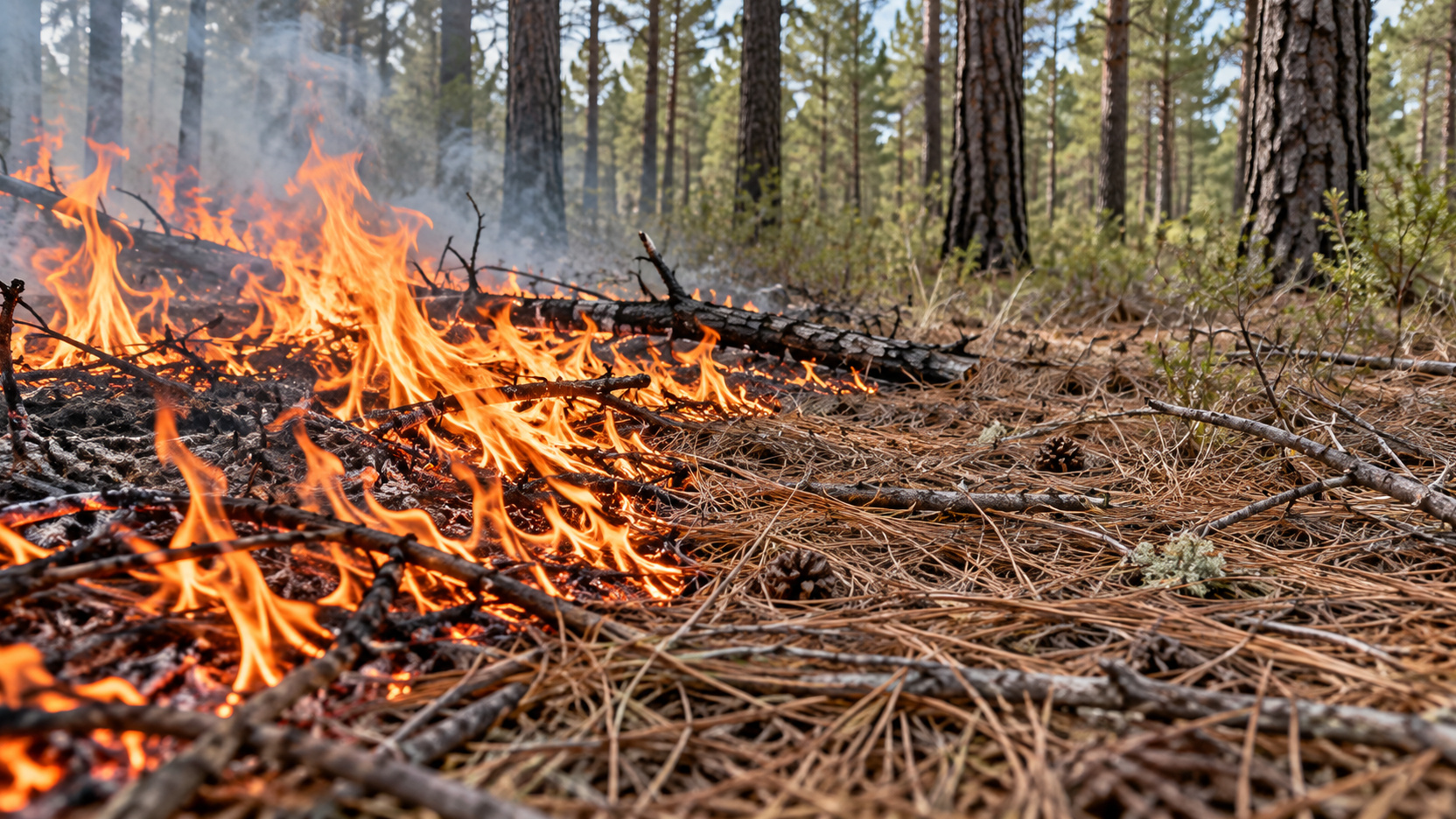
Combustion requires fuel, oxygen, and sufficient heat. In a vegetated landscape, an ignition source supplies heat to material that may be able to sustain burning. Whether that initial combustion grows depends on additional conditions. Moist fuel may absorb energy without igniting readily, while dry fine material can respond quickly. The National Park Service distinguishes the combustion triangle from the fire-behavior triangle of fuels, weather, and topography. Keeping both ideas in view prevents the cause of the first flame from being mistaken for a complete explanation of the later fire.
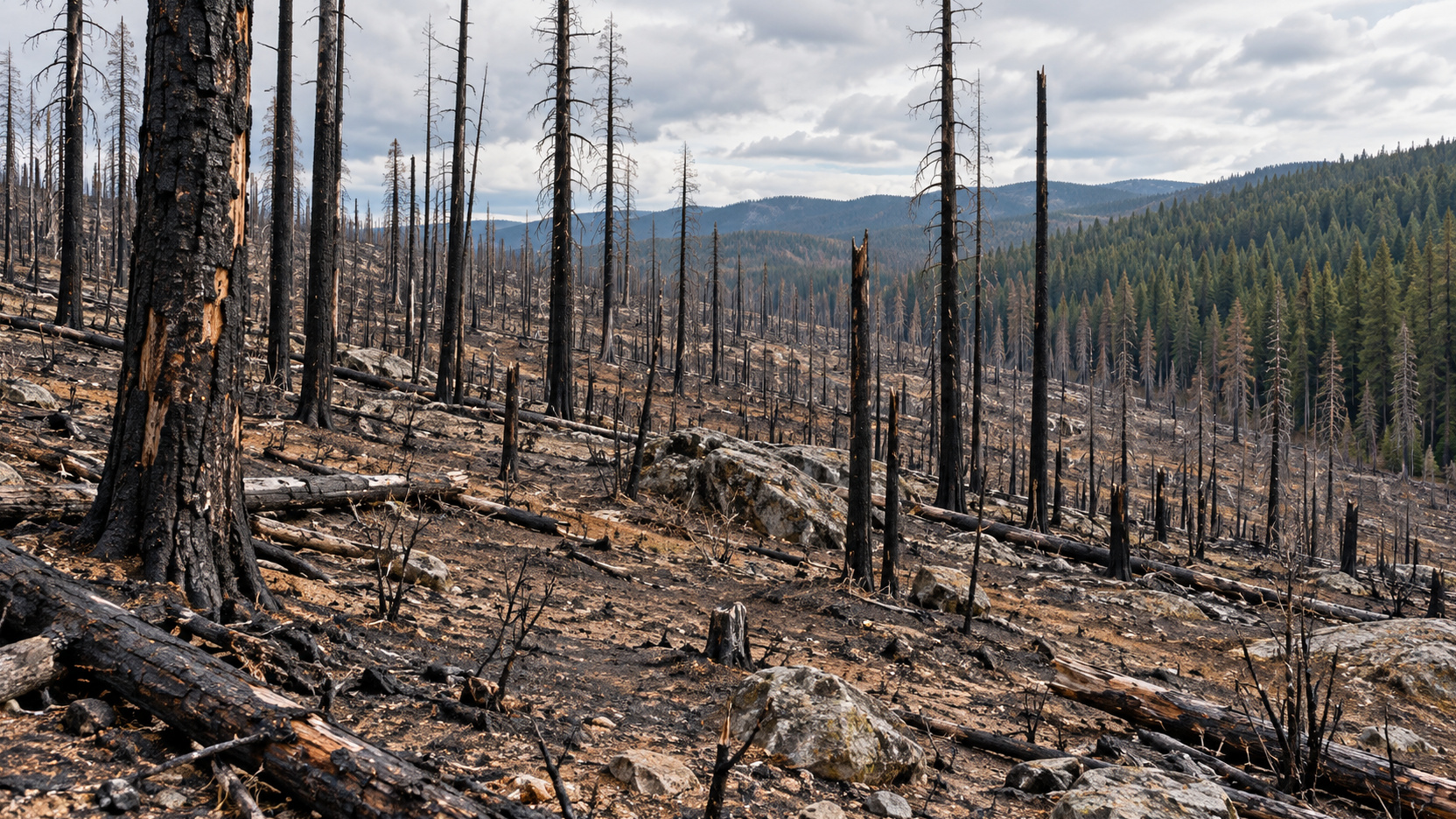
Damage introduces another layer. A rapidly spreading fire far from people has different consequences from a fire entering a populated area, and ecological effects depend on how and what it burns. Buildings may ignite through pathways that differ from the movement of a vegetation fire. A useful account therefore asks what started the event, what allowed it to grow, and what was exposed. These questions can have different answers. The distinction is especially important when a report identifies a suspected ignition source but does not yet explain why the event became destructive.
Natural Ignitions Include Lightning, With Important Qualifications
Lightning can deliver intense heat to vegetation or organic material on the ground. Some lightning ignitions grow promptly, while others smolder before becoming more visible. Rain accompanying a thunderstorm may limit burning, but not every strike is accompanied by enough rain at the ignition point to wet the fuels effectively. The National Park Service identifies lightning as a natural wildfire cause, while Forest Service ignition research examines how environmental conditions influence the transition from an ignition opportunity to a sustained fire. A thunderstorm is therefore neither a guaranteed ignition nor a guaranteed protection.
Volcanic activity can also ignite vegetation in places where lava or other hot material reaches burnable fuels. That is a geographically limited source rather than an explanation for ordinary fires everywhere. Natural ignition categories should be interpreted in their setting. A lightning-rich mountain region, a volcanic landscape, and a heavily visited grassland do not share the same distribution of opportunities. Avoiding a universal percentage is useful here: the relative contribution of ignition sources depends on region, reporting system, time period, and whether the measure is fire count or burned area.
Natural does not mean harmless or automatically desirable. A lightning-started fire can threaten people, infrastructure, or valued habitat under severe conditions. Conversely, fire can play an ecological role in landscapes whose species and processes developed with particular fire regimes. Management decisions consider safety, conditions, objectives, and policy, not just the label attached to the ignition. The origin of a fire is one piece of information. It cannot, by itself, determine its likely behavior, its ecological outcome, or the response that managers should choose.
Human Ignitions Are Not All Deliberate
Human-caused fires include accidental ignitions as well as deliberate burning that is unlawful or escapes its intended limits. Sources can involve equipment, electrical infrastructure, debris burning, campfires, or other activities that place heat near vegetation. The National Park Service and Forest Service describe these categories without treating every human-started fire as arson. An investigation must establish the particular source using evidence. A location near a road or power line may help guide that investigation, but proximity alone does not prove what ignited the fuel.
Human activity also changes when and where ignition opportunities occur. Travel, work, recreation, and settlement can bring sources of heat into landscapes during periods with little lightning. Preventing these ignitions addresses a different part of the causal chain from changing fuel conditions. Both matter, but they are not substitutes for each other. A well-managed fuel landscape can still experience a human ignition, and careful ignition prevention does not remove every natural source. This is why wildfire causation is best understood as interacting opportunities and conditions rather than a contest between two single explanations.
Fuel Is Material, Moisture, and Arrangement
Wildland fuel includes living and dead vegetation, from fine grass blades to fallen branches and standing trees. Size matters because fine material can exchange moisture with the surrounding air more rapidly than large woody material. Moisture matters because water must be heated and evaporated before material burns readily. The Forest Service's fuel resources distinguish surface, ladder, and canopy fuels, reflecting how their position affects fire behavior. A description that says only there was a lot of vegetation leaves out essential information about whether it could ignite and how burning could move.
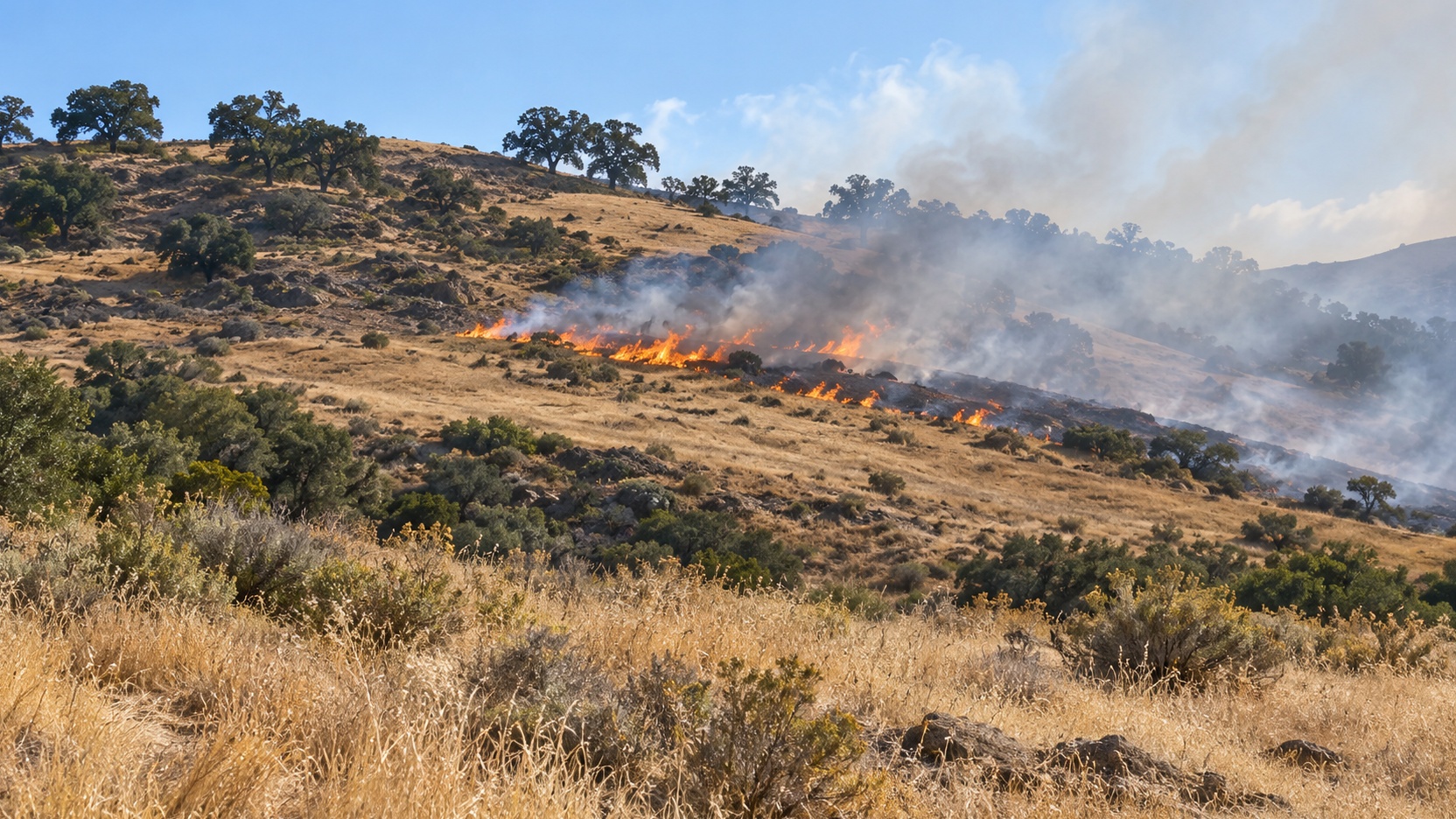
Arrangement helps determine connectivity. Continuous dry grass can support rapid movement across open ground; gaps in fuel can interrupt some pathways. Shrubs and low branches may provide a route from surface flames toward tree crowns, although canopy involvement depends on weather and other conditions as well. Dense material is not automatically more flammable in every configuration, because air circulation and moisture also matter. Fuel assessment considers the structure of the fuel bed, not merely the number of trees or the apparent greenness of a hillside.
Fuel conditions also reflect earlier weather and land use. A wet growing period can produce vegetation that later dries, while prolonged dryness can reduce moisture in existing material. Grazing, invasive plants, logging, fire exclusion, and other changes can modify fuels, with effects that vary among ecosystems. Forest Service research treats these influences as context-dependent. It would be inaccurate to assign every wildfire to excess forest fuel: fires also occur in grasslands and shrublands, and some naturally fire-prone systems respond differently from forests historically shaped by frequent low-intensity burning.
Weather Governs How Readily Burning Can Escalate
Temperature, humidity, wind, and precipitation influence fuels and active fire behavior. Low humidity can favor drying of exposed dead material, while higher moisture can make ignition and sustained burning more difficult. Wind can tilt flames toward fresh fuel, increase heat transfer, and move burning particles ahead of the main fire.
The effects depend on the fuel and terrain. A fire may therefore change behavior as conditions change during a day. A weather description at the time of ignition is not necessarily enough to explain growth several hours later.
Embers, also called firebrands, can start additional fires beyond the main burning edge. The National Wildfire Coordinating Group calls this process spotting. It means spread is not always a continuous line of flames moving across every intervening surface. Where embers land, the condition and arrangement of receptive material determine whether another ignition develops. NIST research examines ember exposure and ignition because these pathways are especially important near buildings. The visible flame front is therefore only one part of the exposure faced by a landscape or community.
Fire-weather alerts describe conditions conducive to dangerous fire behavior; they do not say that a fire is already burning or identify a future ignition source. National Weather Service criteria vary by local climate and fuels. A warning combines information relevant to its forecast area and should be interpreted with current local instructions. This guide does not provide an operational forecast. The causal lesson is that favorable burning conditions can exist before any ignition, and recognizing that distinction helps explain why prevention measures become especially important during particular weather windows.
Terrain Changes Heat Exposure and Wind
Slope, aspect, elevation, and landform can influence fire behavior by changing fuel conditions and the way heat and wind interact with the landscape. Flames and rising hot gases can preheat fuel upslope, often favoring faster uphill spread. Sun-exposed slopes may be warmer and drier than sheltered ones, while valleys and ridges can channel or modify airflow. These are tendencies, not a rule that terrain overrides everything else. Strong winds and changing conditions can produce behavior that a simple uphill diagram misses. The National Park Service's fire-behavior discussion treats topography as one interacting component, alongside fuels and weather. A bare rocky area may interrupt fuel continuity, but a gap does not guarantee protection from wind-carried embers. Reading the landscape therefore means examining several pathways rather than assuming that a river, road, or ridge will always stop a fire.
Climate Influences the Conditions, Not Every Individual Spark
Climate shapes the longer-term patterns of vegetation, dryness, snow, and weather in which fires occur. Warming can increase atmospheric demand for moisture and contribute to drying where water is limited. In some regions, that favors longer or more severe periods of fire-conducive conditions. USDA Climate Hubs and Forest Service research place these effects alongside fuel availability and human influences. The relationship is not uniform because a landscape needs enough burnable material as well as conditions that make it available to burn. A very sparsely vegetated area may remain fuel-limited despite intense heat.
Climate change is therefore not an alternative to a lightning or equipment explanation. One describes an influence on the environment; the other identifies the initiating source. A particular fire may involve both. Quantifying climate influence on a specific event requires analysis of the relevant conditions and comparison with a climate without the same human warming influence. Simply identifying the ignition does not answer that question. Equally, observing hot weather does not establish every detail of climate attribution. The layers of cause should be connected without collapsing them into one claim.
A Fire's Ecological Role Depends on Its Regime
A fire regime describes recurring characteristics such as frequency, season, intensity, and ecological severity. Some landscapes depend on particular kinds of fire to maintain their structure, while other systems can be damaged by fires that recur too often or burn under altered conditions. The National Park Service's Yosemite fire-ecology resources illustrate how excluding fire can change a forest adapted to certain historical patterns. That example does not establish a prescription for every ecosystem. Understanding a fire's causes includes the history that produced its fuels, but judging its effects requires knowing the landscape's ecological context.
Prescribed fire is planned and conducted for stated objectives under specified conditions; it is not synonymous with an unwanted wildfire. It can be used with other treatments to alter fuels or support ecological goals, while still requiring careful management of risk. The National Park Service distinguishes these types of wildland fire. For beginners, the important point is that acknowledging beneficial fire does not minimize dangerous wildfire. Nor does describing destructive fire imply that all burning should be removed from every landscape. Different fire patterns can produce different outcomes in the same broad category of vegetation.
The most reliable answer to what causes wildfires joins the initial heat source with the conditions that sustain and spread combustion. Lightning and human activity explain origins; fuel moisture and structure, weather, and topography explain much of the subsequent behavior. Climate and land management influence those conditions over longer periods, and exposure helps determine the damage. In an active incident, official local alerts and evacuation instructions take priority over a general explainer. Understanding the causal chain is useful because it shows why preventing ignitions, managing appropriate fuels, and reducing exposure address distinct parts of a problem that no single cause can explain completely.