A wildfire advances by heating what has not burned yet
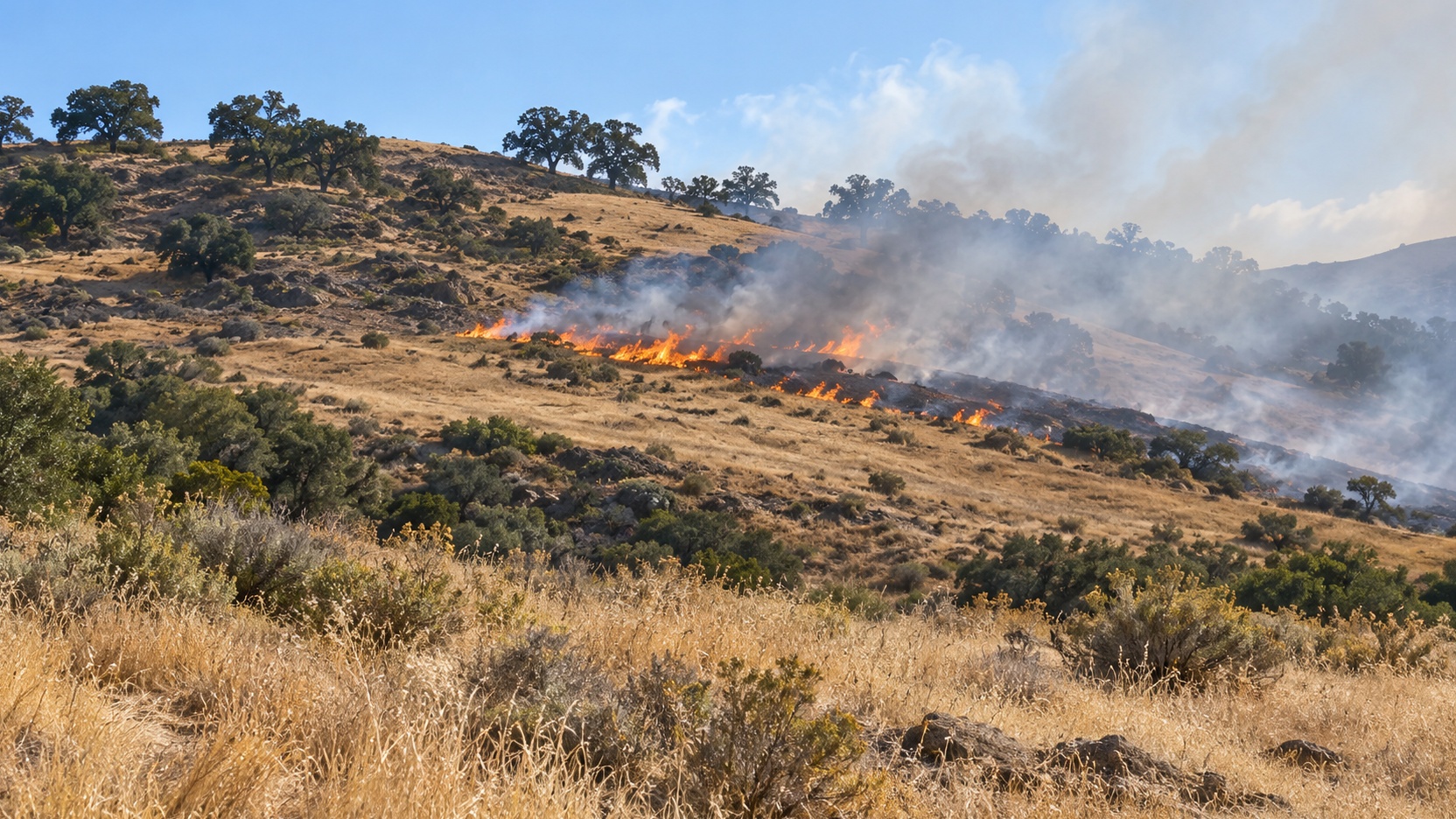
A strip of flame crossing a hillside looks like a single moving object, but it is really a succession of chemical reactions. Burning vegetation releases heat, that heat prepares neighboring material to burn, and the process continues wherever conditions allow. The resulting behavior depends on more than the presence of dry trees: the size and arrangement of fuels, their water content, the movement of air, and the shape of the terrain all influence the next step. A fire may creep through fallen needles, accelerate across cured grass, climb into a canopy, or scatter burning fragments beyond its visible edge. These are different expressions of the same physical problem: how quickly energy reaches fresh fuel and whether that fuel can sustain combustion. Understanding that problem explains both wildfire's extraordinary power and its variability. It also reveals why a dramatic flame front, a deep smoldering burn, and a rapidly expanding fire need not have the same ecological effects.
A: Much of the visible flame comes from combustible products released as the wood heats and decomposes.
A: Insufficient heat transfer, moisture, cooling, or disconnected fuel can prevent the next material from igniting.
A: Fine connected fuels can ignite quickly; spread speed and flame size are different properties.
A: No. Individual torching differs from sustained fire spreading through tree crowns.
A: Airborne fragments can cross gaps, but they start new fires only if they reach receptive fuel with enough remaining heat.
A: An uphill surface can bring vegetation closer to rising flames, increasing exposure under suitable conditions.
A: Persistent combustion can continue consuming material and heating roots or organic soil.
A: No. Fire-generated thunderstorms also require appropriate moisture and atmospheric instability.
A: A hotspot is an instrument-dependent thermal detection, not a complete direct measurement of every flame beneath it.
A: Heat prepares neighboring fuel for ignition; windborne embers can establish that process farther away.
Inside the fuel, before the flame
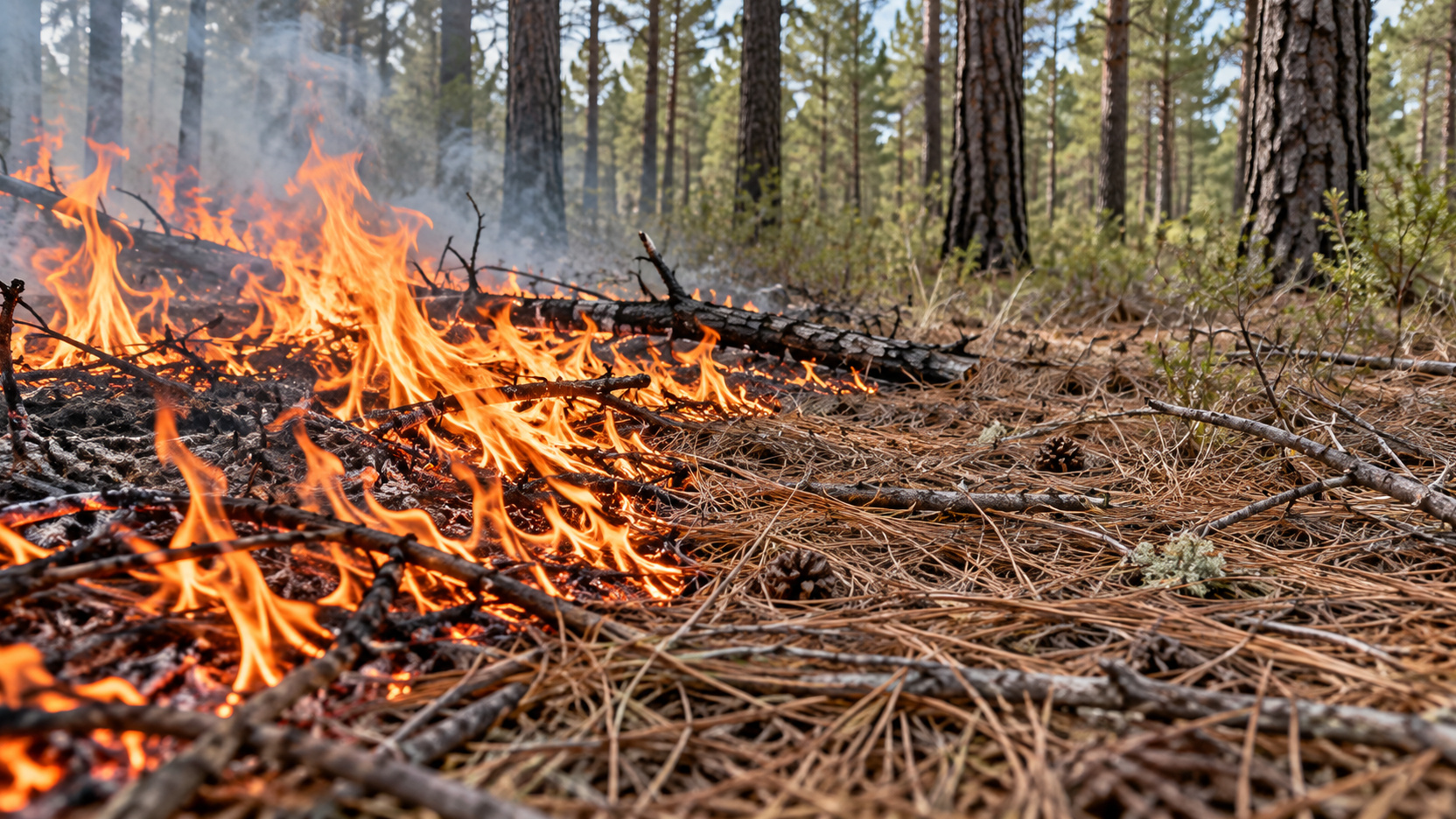
Vegetation stores chemical energy in organic compounds assembled during growth. An ignition source supplies enough initial heat to begin releasing that energy, but a spark does not automatically produce a spreading wildfire. The material first has to warm, lose some of its water, and undergo thermal decomposition. This decomposition, called pyrolysis, releases gases and other products that can burn when they mix with oxygen. Much of the flame visible above a piece of wood is therefore combustion of material leaving the wood, not the solid surface turning directly into flame. The National Wildfire Coordinating Group's definition of pyrolysis describes this preparation stage, which helps explain why a wet branch resists a small ignition even though its dry substance is combustible.
Once combustion releases more heat than the surroundings remove, burning can sustain itself. Some of that energy escapes upward or outward, some warms the fuel still burning, and some reaches material ahead of the fire. If too little useful heat arrives there, the chain stops. A gap, a damp patch, or a change in fuel arrangement can interrupt it without changing the basic chemistry. Conversely, a strong existing fire may ignite material that would not catch from a weak spark. Flammability is consequently a relationship between a fuel and the conditions exposing it to heat, rather than an immutable label attached to a plant. The same leaf can be difficult to ignite when moist and readily combustible after drying.
Three routes carry heat toward unburned vegetation
Radiation transfers energy through electromagnetic waves and does not require the flame to touch its target. Anyone who has felt warmth beside a small fire has experienced the principle. In a wildfire, nearby leaves and stems absorb part of the radiation from flames and hot material. Their position, exposure, and distance affect how much energy they receive. A large flame front can expose a broad area of vegetation, but shielding and gaps make that exposure uneven. The heated surface must still reach conditions compatible with ignition; radiation alone is not a guarantee that every nearby object will burn.
Convection moves heat with flowing gases. Rising hot air carries energy upward, while wind can push flames and heated gases toward fresh fuel. Turbulent motion makes the contact intermittent and highly variable, so the edge of a fire is not a smooth laboratory burner. Small branches can be enveloped by moving flame for a moment, then exposed to cooler air. The balance over those changing moments determines whether they ignite. Conduction, the third mechanism, transfers heat through direct contact within or between materials. It is important inside a log or soil layer, though it does not explain a flame front leaping across open space.
These processes act together rather than taking turns in separate categories. A twig may be warmed by radiation before hot gases surround it, while heat conducts inward from its surface. Thinking in terms of combined energy transfer is more useful than trying to assign an entire wildfire to one mechanism. It explains why the orientation of vegetation matters and why conditions near the ground differ from those in a crown. NWCG's heat-transfer terminology provides the physical distinctions, but an actual fire continually blends them into a changing pattern of heating and cooling.
Fuel architecture controls what the fire can reach
A grassy field and a pile of thick logs can contain very different pathways for combustion. Fine fuels have a large exposed surface relative to their volume, allowing rapid exchange of heat and moisture with their surroundings. They may ignite and carry a flame front quickly while contributing less prolonged burning at any one point. Coarse wood responds more slowly and can remain involved after the front has passed. Arrangement is just as consequential as quantity: closely connected stems provide successive targets, while sparse plants separated by bare mineral soil may leave insufficient opportunities for spread. Extremely tight packing can also restrict airflow, so adding more material does not always increase burning in a simple proportional way.
Vertical arrangement determines whether flames can move beyond the surface layer. Low branches, shrubs, and small trees can link ground fuels to higher foliage; fire specialists call such connections ladder fuels. A surface fire can torch an individual tree without becoming a sustained crown fire, which requires conditions that support further spread through the canopy. These distinctions describe pathways, not fixed stages every fire must follow. An open stand with raised crowns behaves differently from a stand with continuous foliage near the ground, even if both appear densely wooded from above. Fuel maps therefore need information about structure and condition, not merely a forest symbol on a map.
Water sets an energy cost for ignition
Before wet material burns readily, energy must heat and evaporate water that would otherwise absorb part of the incoming heat. Moisture thus competes with the process preparing fuel for combustion. Dead leaves and twigs exchange water with the atmosphere, whereas living foliage also reflects roots, physiology, and seasonal growth. A shower can wet the exposed surface without fully reversing dryness inside a large fallen trunk. Equally, several dry hours can alter fine exposed material while sheltered or thicker fuels retain a different moisture history. NWCG's fuel-moisture guidance emphasizes these contrasting response times. For interpreting behavior, the useful question is not simply whether rain fell recently, but what material became wet, how deeply it was wetted, and what happened afterward. Sunlight, shade, humidity, and airflow can produce different answers within the same small area. This is why a fire can slow in one patch and resume vigorous spread a short distance away without encountering a new ignition source.
Wind and slopes change the next heating opportunity
Wind does more than supply oxygen. It can tilt a flame toward unburned fuel, increase contact with hot gases, and carry burning fragments away from their source. A wind change can make what was a flank become a more actively advancing edge. Speed and direction measured at a distant weather station may not represent the air moving among trees or through a narrow drainage. Vegetation, terrain, and the fire itself disturb that flow. The implication is a moving boundary condition: the fuel ahead of the fire can remain the same while its exposure to heat changes rapidly.
An upslope surface lies closer to flames rising from below, which can increase preheating and favor faster uphill spread. This tendency is conditional, not a rule that downhill spread is harmless or impossible. Wind may align with a slope, oppose it, or dominate a different direction altogether. Gullies and ridges can redirect air, while contrasting sun exposure changes vegetation and fuel moisture over longer periods. Several influences therefore coincide on a hillside: immediate geometry, local airflow, and accumulated drying. Separating those influences helps explain why slope angle by itself cannot predict a fire's speed.
A fire front also has different moving parts. The head commonly advances most vigorously under the prevailing combination of wind and terrain, while backing and flanking portions encounter different heating conditions. These terms help describe shape without implying that the perimeter stays stable. A sudden gust, a fuel transition, or new spot fires can reorganize it. A map drawn at one moment is a record of where burning has occurred, not a durable outline of where it will remain. Scientific understanding clarifies the mechanisms, but it does not turn an unfamiliar active fire into something a bystander can judge safely from appearance.
Embers and plumes allow behavior beyond the visible edge
Spotting occurs when burning material is lofted, transported, and deposited where it starts another fire. Every step matters: the fragment has to be produced, remain capable of ignition during travel, land on receptive material, and deliver sufficient heat. Many fragments fail to complete that chain. Those that succeed can establish burning beyond a road, a stream, or an apparently quiet patch. The advancing perimeter can then be shaped by the merger of separate fires, not only by continuous flames moving across the ground. This mechanism is especially important for understanding why an unburned gap is not equivalent to guaranteed separation from a wildfire.
Strong heating can produce a vigorous rising plume, drawing surrounding air into the column. In suitable atmospheric conditions, cooling in that rising air allows moisture to condense and form a fire-associated cloud. Some exceptional events develop pyrocumulonimbus, or fire-generated thunderstorms, which involve a much stronger connection between the fire and the atmosphere. NASA's airborne observations of a fire cloud document this phenomenon without suggesting that every large smoke column is a thunderstorm. The atmosphere must cooperate as well as the fire. A dark plume can be visually impressive while lacking the cloud structure, moisture, and instability required for that further development.
Flame size cannot tell the whole scientific story
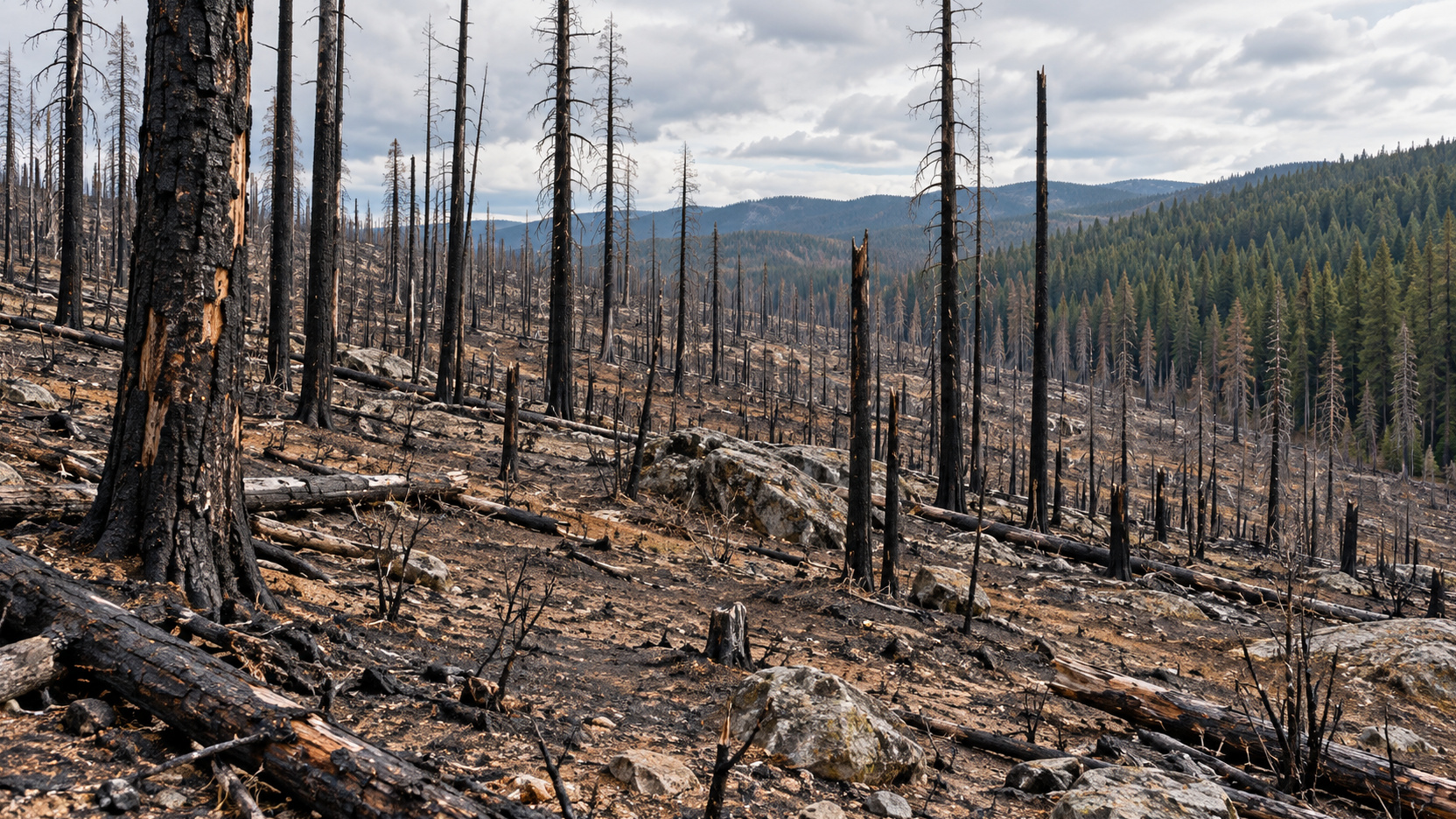
Fire intensity concerns the rate of energy release, while ecological severity concerns resulting changes to vegetation, soils, or other components. A brief, fast-moving front and a persistent smoldering layer can leave different effects even when one has much taller flames. Residence time, the duration of heating at a location, helps explain that difference. Deep organic material can smolder without the dramatic appearance of a crown fire, yet prolonged heating may affect roots or consume stored organic matter. Calling one fire more powerful therefore requires specifying which quantity is being compared: energy release, spread, total consumption, or ecological change.
Scientists combine observations because no single instrument captures every quantity directly. A satellite can locate thermal activity or changes in vegetation reflectance; field measurements can examine fuel moisture, consumed material, and surviving plants. Weather records and terrain data supply additional context for interpreting those signals. Each measurement has a scale and a limitation. A thermal detection is not a complete description of the ground underneath it, and a later image of canopy loss is not a direct recording of flame temperature. Models use these different observations to estimate behavior, with uncertainty increasing when conditions depart from their assumptions.
The central insight is a feedback between burning and preheating. Fuel, moisture, wind, and topography determine whether that feedback weakens, persists, or accelerates, while embers can start it elsewhere. This physical explanation makes wildfire neither mysterious nor fully predictable. It replaces the idea of a single unstoppable wall with a system of interacting processes whose importance changes from place to place. Forecasting requires updating those conditions as they evolve, because yesterday's fuel sample or an earlier wind observation may no longer represent the advancing edge. The question is always where heat is going now and which material it can prepare next. For readers, that is a more accurate understanding of wildfire's power than any image of towering flames: a local chemical reaction can become a landscape-scale event when energy transfer and connected combustible material repeatedly sustain the next ignition.