An Arctic tern, a godwit, and a monarch make different kinds of extraordinary journey
An Arctic tern can link northern breeding grounds with waters around Antarctica. A bar-tailed godwit can cross the Pacific from Alaska toward New Zealand without a feeding stop. A monarch butterfly joins a seasonal movement whose full annual cycle involves successive generations. These journeys differ in scale and organization, but each connects opportunities that one place cannot provide throughout the year. Food, breeding habitat, seasonal conditions, and survival help explain why the cost of moving can be worthwhile. Migration is therefore more than escape from cold, and an impressive distance is only the beginning of the story. Following these actual travelers reveals what the journey makes possible, what it costs, and why an animal can depend on a chain of habitats far beyond the place where people happen to see it.
A: It connects northern breeding opportunities with distant Southern Ocean feeding environments during the nonbreeding period.
A: Inherited programs, cues, learning, and social information can guide behavior.
A: Reliable resources or safer conditions can outweigh extra distance.
A: Its connection between necessary habitats can be essential.
A: Partial migration includes both migrants and more resident individuals.
A: It may be a necessary link with few alternatives.
A: Some patterns are completed across multiple generations.
A: Migration commonly recurs within a seasonal or life-cycle pattern.
A: Food, weather, or nesting conditions may not yet support the animal, even when an earlier journey helps match a later resource peak.
A: It can restore energy and condition before the animal begins another demanding passage.
Arctic terns connect northern breeding with the Southern Ocean
Tracking published in 2010 followed Arctic terns from Greenland and Iceland to the Southern Ocean and back. The study by Carsten Egevang and colleagues reported an average annual migration distance of about 70,900 kilometers for the eleven tracked birds, with substantial variation among individuals. This figure includes different stages of their movement rather than one direct flight between the poles. The route demonstrates the scale of a life organized around distant seasonal environments.
Northern breeding grounds provide the terns with a seasonal place to raise young. Later, feeding waters far to the south support another part of their year. Winds and the distribution of prey shape the route between these opportunities, so a successful journey can follow a much longer path than the shortest line between the poles. The bird carries and replenishes reserves as its annual needs change. Food encountered along the way supports the next stage of travel, while timing determines when it can use the breeding destination. Its movement connects habitats separated by a huge distance through the requirements of one small animal.
Breeding and feeding can require different places
Reproduction can favor conditions unlike those supporting adults during the rest of the year. Suitable nesting sites, nursery habitat, reduced exposure to some predators, or access to food for developing young can make a seasonal destination valuable. Animals then need to leave or shift habitats when those benefits diminish. This helps explain journeys that do not follow a simple movement from colder places to warmer ones. The relevant question is which conditions support each life stage. An adult may tolerate a setting where its offspring cannot develop successfully, or may feed efficiently somewhere that lacks a suitable place to reproduce. Migration links these requirements rather than demanding that one location provide them all at once.
Evolution explains persistence without giving animals foresight
Migration can become part of a life history when heritable differences and learned behavior influence survival and reproduction over generations. Individuals do not need to understand the global seasonal map for a movement strategy to produce an advantage. They respond through biological programs, environmental cues, experience, and social information in combinations that vary by species. Natural selection acts on the consequences of those differences. The result can look purposeful without requiring an animal to predict every future event along the route.
A regular cue can start preparation before the benefits of leaving become visible locally. Changing daylight, for example, can be associated with readiness for a season when a distant habitat becomes useful. The cue initiates behavior, while feeding and breeding opportunities explain what the journey enables. An animal can therefore prepare while food remains at home, using an annual rhythm that generally places it in another environment at a suitable time. Weather and its own condition then influence when it actually begins moving.
Strategies can change as conditions and populations change. Migration is not a perfect inherited solution that remains equally effective forever. Variation among individuals can influence which responses persist, while learning can adjust parts of a route or schedule. The pace of environmental change matters because a historically useful pattern may become less well matched to current conditions. Observing the continuation of a journey does not prove that its former benefits remain intact.
A godwit's Pacific crossing makes the cost of travel tangible
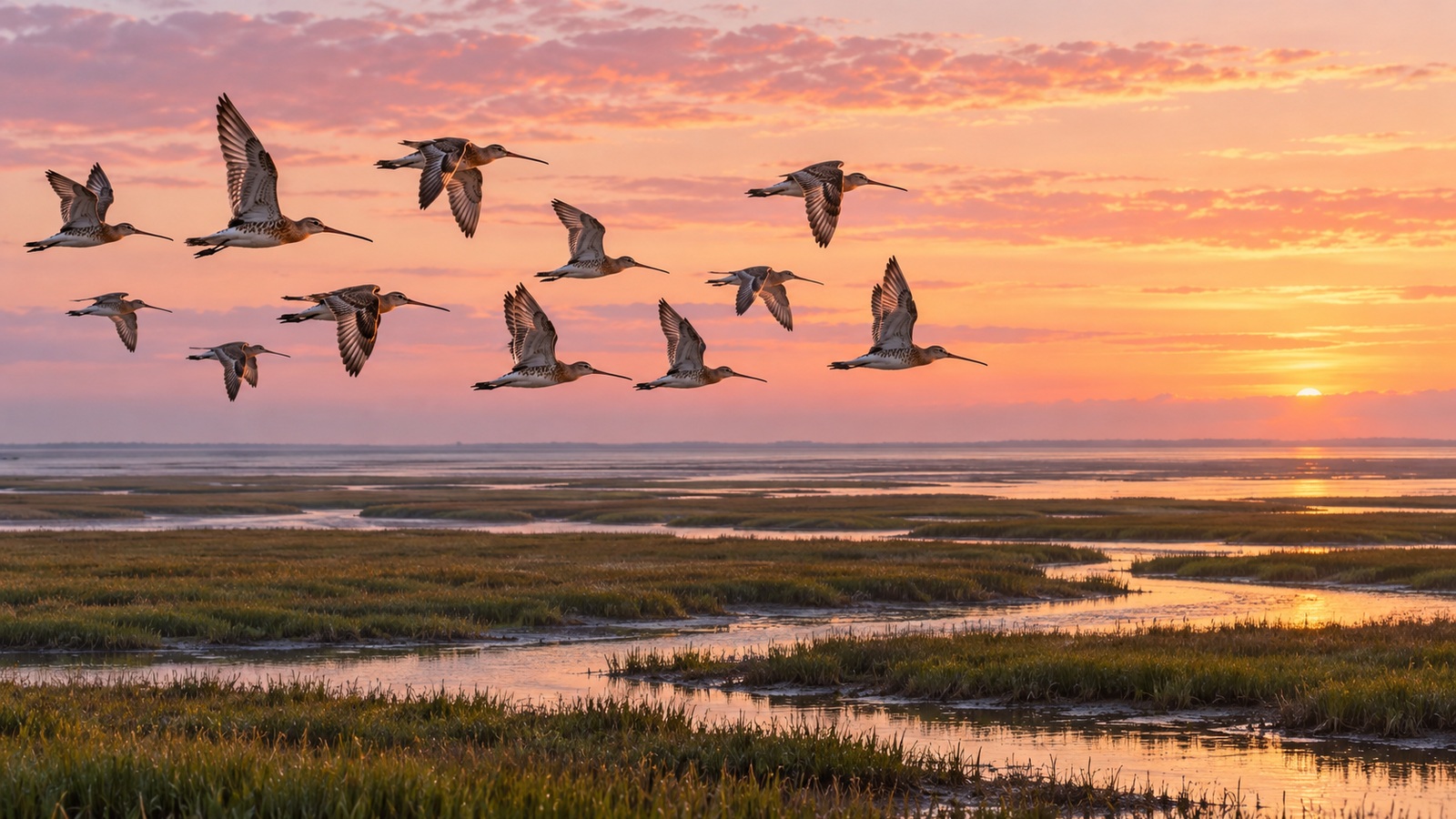
Alaska-breeding bar-tailed godwits, Limosa lapponica baueri, undertake a southbound ocean crossing toward New Zealand and Australia. A USGS account drawing on migration research describes nonstop flights of up to roughly 11,000 kilometers. Unlike a traveler moving between frequent feeding patches, a bird on that crossing must carry the resources needed to remain airborne until it reaches land. The remarkable distance is therefore inseparable from preparation and the conditions encountered over open water.
The return journey has a different organization, with staging along the Yellow Sea coast before the birds continue toward Alaska. This contrast shows why a migration strategy is larger than its most famous flight. A nonstop southbound segment does not make stopover habitat irrelevant to the annual cycle. The animal needs both the ability to cross a major barrier and access to places where it can feed before or after other stages. Storms, winds, delays, and the condition in which it departs affect the balance. Losing a feeding area can consequently undermine a journey that takes place thousands of kilometers away, even when the distant breeding site remains intact.
Stopover habitat can be as necessary as a distant destination
Many migrants need places to rest or refuel between longer movements. A small wetland, patch of vegetation, shoreline, or sheltered feeding area may serve as a critical link in a much larger route. Its importance depends on what alternatives are available and the condition in which animals arrive. Losing a bottleneck site can have consequences disproportionate to its area, especially where the next suitable habitat lies beyond the reserves animals can carry. Conservation cannot be based only on the size or visual grandeur of a destination. It must also consider the modest-looking places that make reaching it possible and the quality of those places during the season when migrants use them.
Not every member of a population makes the same journey
Partial migration occurs when some individuals migrate while others remain more resident. Differences in resources, competition, body condition, breeding strategy, or environmental exposure can influence those choices. A resident individual is not necessarily failing to perform the species’ normal behavior, nor is a migrant automatically the more successful strategy. Outcomes depend on conditions and the costs and benefits experienced by each animal. Population-level labels can hide this individual variation.
Movement can also differ in distance and direction. Some animals migrate between elevations, some shift across relatively short regional distances, and others travel across continents or oceans. A journey does not need to be record-breaking to have ecological significance. An elevational movement can connect essential seasonal habitats, while a relatively short passage may cross a highly consequential barrier. The function of the movement is more informative than ranking animals by the number of kilometers they cover.
Migration usually recurs as part of a seasonal or life-cycle pattern. Dispersal more often involves leaving an origin and establishing somewhere else, such as a young animal moving away from its birthplace. An individual can experience both kinds of movement at different points in life. In some insects, successive generations carry the recurring population cycle, so the return to an earlier region does not belong to one returning individual. The pattern emerges through travel and reproduction together rather than requiring every animal to complete a personal round trip.
Monarchs link Mexico with a northward sequence of generations
Monarchs east of the Rocky Mountains move between breeding areas in the United States and Canada and overwintering forest in central Mexico. The US Fish and Wildlife Service describes this long-distance migration alongside the distinct western overwintering pattern in coastal California. The eastern annual cycle is not one butterfly making every leg of a round trip: reproduction connects successive northward generations, while a later generation undertakes the long southward movement. Nectar resources support adults, and milkweed supports the developing caterpillars. Protecting only the Mexican winter gathering would therefore leave out the breeding places and feeding opportunities that produce the next travelers. This is a different solution from a long-lived bird returning to its own previous destination. The continuity belongs to a population’s seasonal cycle, with individual movement and reproduction carrying different parts of the work.
Migration moves ecological effects between places
Migrants consume resources, become prey, transport nutrients, disperse some organisms or materials, and connect communities that would otherwise interact less directly. Their arrival can influence local food webs, while their departure changes the resources remaining for residents. These effects differ among species and habitats. Migration is therefore both a response to ecological conditions and a process shaping them. It belongs in an ecosystem explanation rather than being treated only as an extraordinary feat by an isolated animal.
The same connections can cross administrative boundaries. One jurisdiction may protect a breeding area while another controls a feeding ground or a passage route. Actions in either place can influence the shared population. Conservation agreements and cooperation become useful because the biological system does not stop at a border. The objective is to maintain a complete sequence of suitable conditions, with attention to local communities and the distribution of responsibilities along the route.
Rapid environmental change can undermine a familiar strategy
Climate change can alter the timing of food, water, snow, ice, or suitable temperatures at different parts of a route. An animal may use a departure cue that changes less quickly than the conditions it encounters later. Habitat conversion, barriers, artificial light, and other human pressures can add further difficulty. The resulting risk is not simply that animals need to move farther. Their established sequence may no longer connect the resources required at the right times.
Changing a route takes more than selecting a new direction. An alternative has to contain usable food and resting places within reach, while an earlier departure can expose the traveler to poorer conditions before those resources develop. Some individuals adjust successfully and others encounter a tighter energy budget. Their arrival condition then affects breeding and later survival. Flexibility creates options, but it operates within the habitats actually available along the route.
Losses during different stages can compound. An adult arriving in adequate breeding condition can still encounter too little food to raise young, while a successful breeding season can be followed by poor survival during passage. A degraded stopover can leave birds with fewer reserves for the next crossing, extending its influence well beyond its own location. The population depends on those successive outcomes across the year. Protecting a site at one stage therefore supports the larger journey most effectively when the habitats used before and afterward remain viable too.
Protection works when it follows the whole journey
A migration route is sustained by places available at the right times. Stopovers provide food and rest, corridors preserve passage, and destinations support activities such as breeding or overwintering. Barriers, disturbance, and deteriorating habitat can interrupt those roles even where the animal’s timing and direction remain effective. Protection along the route gives a traveler access to the opportunities its behavior is organized to reach. Cooperation matters because many of those places fall within different land uses or jurisdictions.
Animals migrate because a moving strategy can provide a better sequence of opportunities than remaining in one place. That strategy succeeds through tradeoffs, preparation, timing, and access to connected habitats. Its value is measured in survival and reproduction rather than distance records or the beauty of a mass departure. Understanding those relationships makes the journeys more remarkable and conservation more precise. It directs attention to the full chain of places and conditions that allows movement to remain a workable way of life.