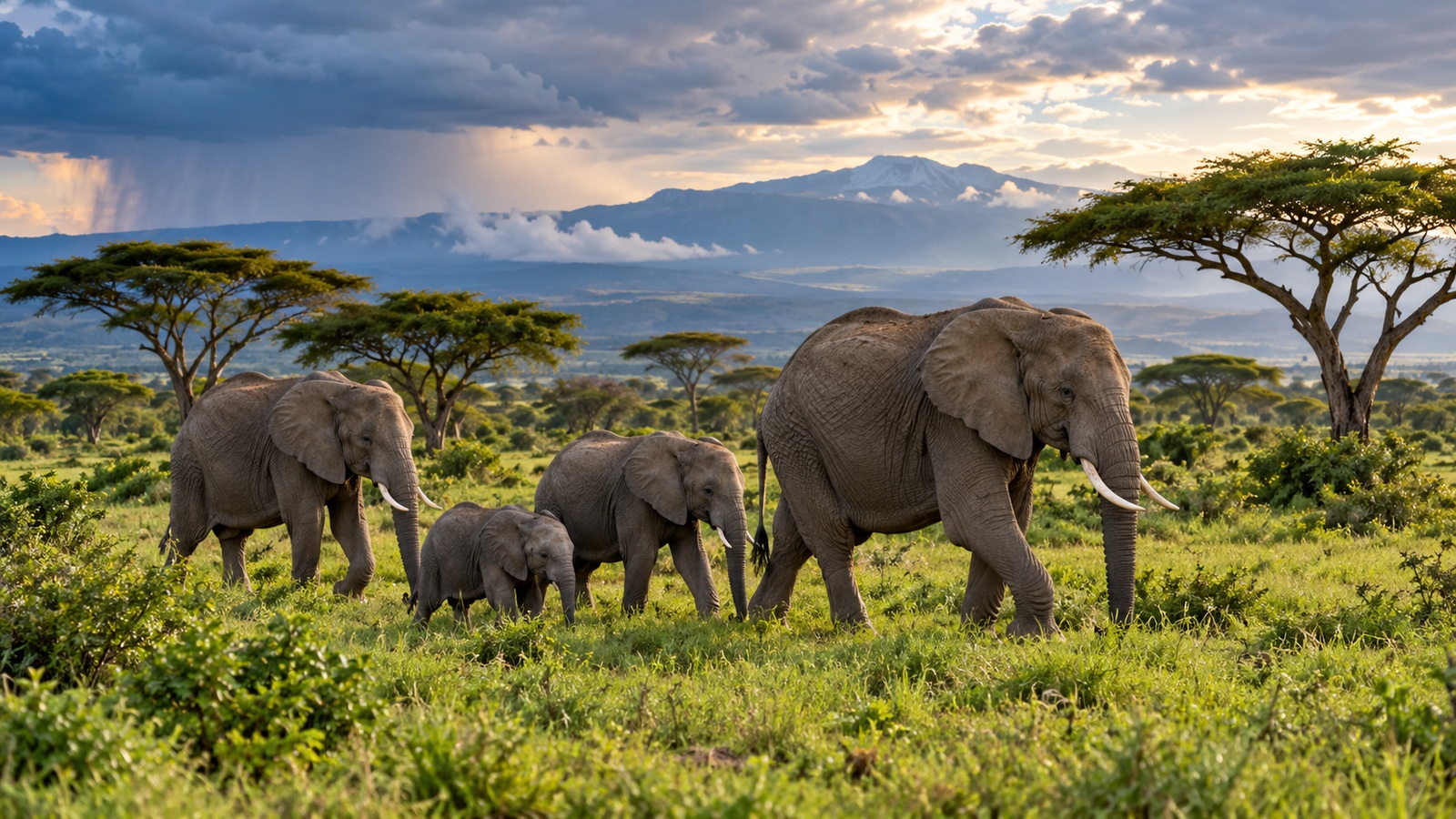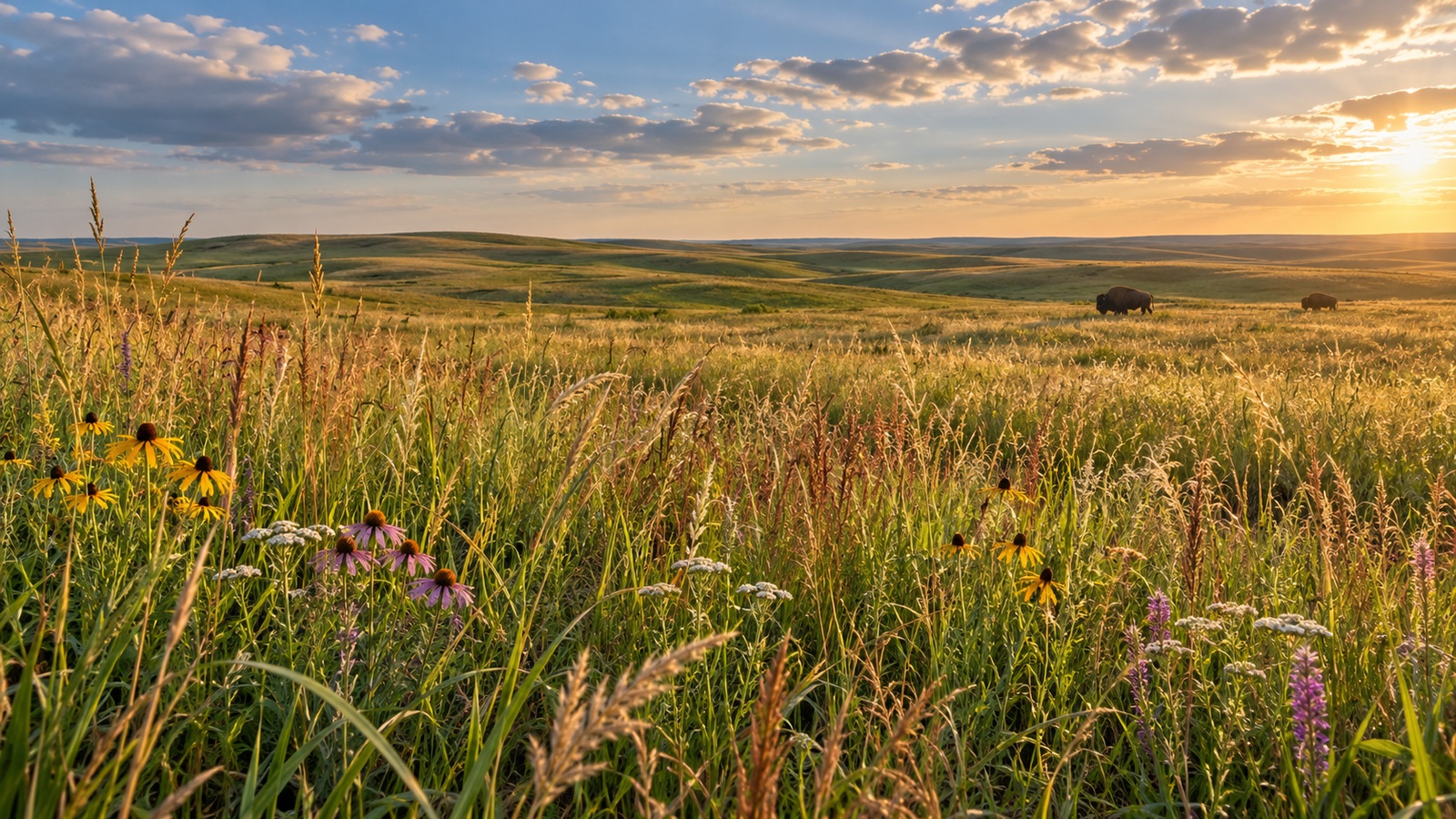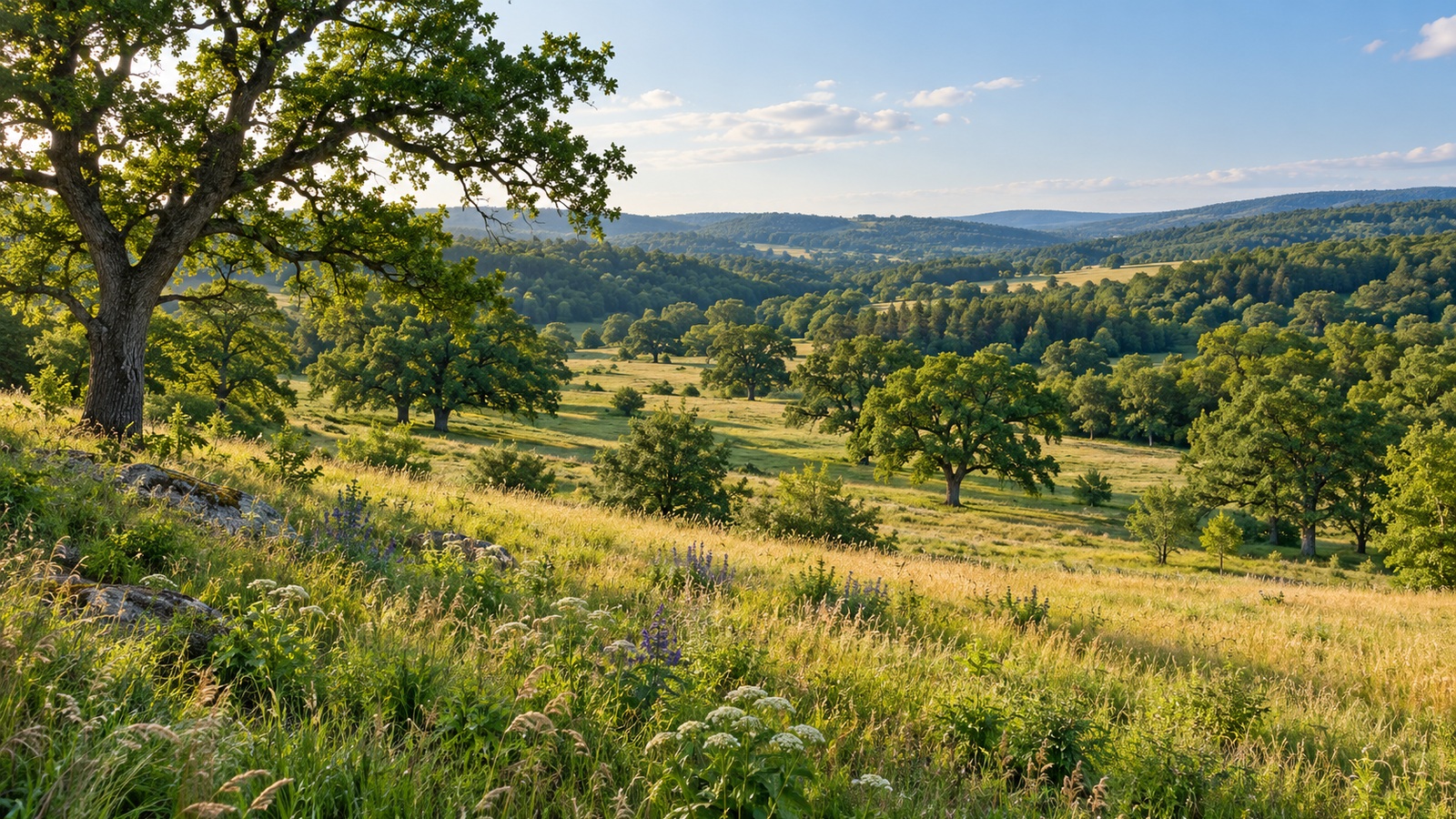
Savannas have an open woody layer above a grassy understory
Grasslands and savannas share an important feature: grasses and other low-growing plants occupy much of the ground. Their clearest difference is the woody layer. Grasslands are dominated by herbaceous vegetation with relatively little tree or shrub cover, while savannas combine that ground layer with scattered woody plants and enough light for grasses beneath them. Neither category belongs to only one continent or climate. Temperate oak savannas and tropical grasslands broaden the familiar images of African wildlife plains and North American prairies. Fire, grazing, rainfall, soils, and land-use history influence how the layers develop, and neighboring patches can form gradual transitions. Those relationships give both landscapes their own habitat value. An open prairie supports organisms that may lose suitable conditions as trees spread, while a savanna’s native trees can be central to the community living below and among them.
A: Yes. Hoosier Prairie includes prairie openings and dry black-oak savannas within one varied landscape.
A: Oak savannas are a familiar example.
A: Definitions can permit limited woody cover.
A: Vegetation structure and the classification context also matter.
A: Soils, fire, herbivory, and history also contribute.
A: Species adapted to open habitat can lose suitable conditions.
A: Important soil and root pools remain unseen.
A: Thresholds, resolution, and classification purposes differ.
A: Its value depends on the original ecosystem and objectives.
A: Removing dense growth may restore light in a savanna, while removing its established native trees can eliminate habitat that belongs in that community.
Grassland is a broad category of herbaceous dominance
Grasslands contain vegetation dominated by grasses and other herbaceous plants, with woody cover limited under the definition being used. Their plant communities can include many wildflowers and other nongrass species. The category covers very different climates, soils, and disturbance histories. A short, dry grassland and a wetter tallgrass prairie can share herbaceous dominance while differing strongly in height, productivity, and wildlife. Calling them both grassland identifies a broad structural feature rather than a complete ecological description.
A pasture or planted grass field can share herbaceous dominance without containing the native species and long history of a prairie. Repeated mowing, grazing, reseeding, and input use create different conditions from those in a less modified community. Wildflowers, insects, soil organisms, and seasonal growth patterns can consequently differ beneath a similar green appearance. The broad grassland form includes that variety, while the particular plant community determines much of the habitat available within it.
Savanna combines a grassy layer with an open woody layer
Savanna trees or shrubs stand above an important layer of grasses and other herbaceous plants. Their crowns cast patches of shade rather than forming a continuous closed canopy, allowing sunlit growth between and beneath them. Trees add branches, bark, litter, and roots that support different organisms from those using open grass alone. That structure develops through time as woody plants establish, survive disturbances, and interact with the ground layer. A few isolated trees may occur in a broadly grassy landscape without creating the same pattern, while an opening left in a forest has another history. Across a savanna, the spacing and size of the woody plants help determine how much light, food, and shelter the layers provide.
Climate influences both landscapes without drawing a single boundary
Many familiar savannas occur in tropical or subtropical regions with seasonal rainfall, while many familiar prairies and steppes occur in temperate regions. Those associations are helpful examples, not complete definitions. Tropical grasslands and temperate savannas also exist under common ecological terminology. The National Park Service’s oak-savanna description illustrates an open tree-and-grass community outside the stereotypical tropical setting. Climate categories and vegetation categories answer different questions and should not be collapsed into one another.
Rainfall affects what vegetation could potentially grow, but soils, drainage, fire, herbivory, and land-use history influence what actually persists. A wetter site may support more woody growth under one disturbance pattern and remain relatively open under another. Local nutrient conditions and rooting opportunities add further variation. There is consequently no single rainfall total that turns every grassland into savanna or every savanna into forest. The boundary is produced by interacting processes, with the strength of each process changing among places.
Seasonality also matters. The same annual rainfall delivered in different patterns can create different periods of plant growth and stress. Cold seasons may limit growth in one region, while dry seasons are more prominent in another. Comparing ecosystems therefore requires the distribution of resources and constraints through the year, not only the annual averages. The visual resemblance between two open landscapes can conceal very different calendars of ecological opportunity.
Fire and herbivory can maintain openness through different pathways
Fire can limit woody recruitment, remove litter, and change the conditions experienced by herbaceous plants. Herbivores can remove grass, browse young trees, disturb surfaces, and redistribute nutrients. Their effects interact rather than adding up as independent switches. Removing grass can alter the fuel available to a later fire, while a change in tree shade can alter grass growth. The same broad processes occur in both grasslands and savannas, but their roles and suitable patterns differ.
Fire and herbivory change each other’s effects. Grazing removes grass that might later carry a burn, while browsing can reduce the young woody plants that would otherwise grow above it. Fire can remove litter and expose the ground to new growth after rain. Where pressure is repeatedly concentrated, plants may have too little time to recover; where disturbance is excluded, some woody cover can become denser. The resulting vegetation depends on the sequence, season, and intensity of those processes. The same action can therefore produce different changes in two communities with different species and histories.
Woody plants change habitat without automatically improving it
Scattered trees can provide shade, nesting structures, perches, food, and conditions used by species absent from an otherwise open field. At the same time, some grassland species require broad open areas and avoid woody edges. Adding trees can therefore improve conditions for one group while reducing them for another. Biodiversity is not a simple function that always rises with tree number. The appropriate goal depends on the native community, the landscape context, and the organisms being conserved. A naturally open grassland should not be judged incomplete because it lacks the features of a savanna, just as a functioning savanna should not be judged successful only after every tree has been removed.
Roots, soils, and shade shape the less visible differences
Roots distribute living material through the ground in both grasslands and savannas. Dead roots and other inputs supply organic matter to soil, where microbes transform it and release some through respiration. Savanna trees add woody material above and below the surface, while a grassland can retain a large store through perennial roots and soil accumulated over time. Deep organic deposits, shallow rocky ground, disturbance, and climate all alter that distribution. The visible canopy therefore reveals only part of the ecosystem’s material, with important differences continuing beneath a similar open horizon.
Woody crowns also change the environment under them. Shade alters the sunlight reaching grasses, and litter adds a different surface material from the stems and leaves between trees. Roots use water from the ground, with patterns shaped by species, soil, and season. Increasing woody cover can consequently change the water available to neighboring plants as well as the structure seen above ground. Rainfall and evaporation continue to affect the whole landscape, while local differences create wetter, drier, sunnier, and more sheltered patches used by different organisms.
A grassland and a savanna can thus share processes while allocating their resources differently. Perennial grass roots may support regrowth after leaf loss, while surviving woody plants continue providing branches, shade, and litter above the ground layer. A drought changes the balance of growth and water use; fire changes the material and plants that remain afterward. The contrast develops through those interacting layers rather than through a tree count alone. Soil and the life it supports connect the present vegetation with earlier seasons and disturbances in both systems.
Real landscapes often contain mosaics and gradual transitions
A region may contain open grassland, scattered trees, denser woodland, wet depressions, and rocky patches within a relatively short distance. Soil, slope, moisture, disturbance, and historical use can create that mosaic. The boundary seen on a map may summarize a gradual change or combine several patch types. Different mapping resolutions can therefore assign different labels to the same broader landscape without necessarily disagreeing about every observation on the ground.
Transitions can also occur over time. Woody expansion may change an open community, while clearing or repeated disturbance may reduce woody cover. Whether that transition represents restoration, degradation, or another change depends on the reference conditions and objectives. Increasing trees in a degraded forest setting is different from increasing them in an intact native grassland. The direction of canopy change alone does not determine its ecological value. History and function are essential to interpreting the trend.
Animals respond to the vegetation structure around them
An animal uses the cover, food, temperature, and space around it rather than a landscape’s classification. A bird requiring a broad open nesting area may find fewer suitable places as woody edges spread. Another can gain perches or nest sites when scattered trees establish. Grazers encounter the grass layer, browsers use woody foliage, and many smaller organisms depend on flowers, litter, or shelter at ground level. Those requirements can change across life stages and seasons. A gradual shift from open grass to scattered trees can consequently rearrange the community before the area begins to resemble a closed forest. The ecological contrast is carried in those changing opportunities for feeding, breeding, and survival.
Conservation should protect the system rather than pursue a preferred silhouette
For native grasslands, priorities may include protecting open habitat, retaining plant diversity, preventing conversion, and maintaining appropriate disturbance. For savannas, conserving the functioning relationship between woody and herbaceous layers can be central alongside movement routes and community uses. The practical actions vary among locations. Both can face fragmentation, invasive species, altered fire, unsustainable pressure, and climate change, but the appropriate response needs to address the actual mechanism involved.
Restoring a native savanna can involve retaining established trees while reducing a dense understory that blocks light from the grassy layer. Restoring an open prairie can instead involve preventing woody expansion that removes habitat for sun-loving plants and open-country wildlife. The vegetation being recovered differs, so clearing and planting have different roles in the two settings. Community knowledge and land-use history help connect present work with those earlier conditions. Recovery then develops through the plants that establish, the structure they create, and the continuing disturbance and water conditions supporting them.
A walk at Hoosier Prairie makes the distinction tangible
At Hoosier Prairie in Indiana Dunes National Park, the National Park Service describes dry black-oak savanna on sandy rises, prairie openings on slopes, and wetter communities in depressions. These habitats share a landscape rather than occupying separate climate zones. Walking between them can change the woody layer, moisture, and plant community without taking the observer to a different continent. The example resolves a common misconception: savanna is not simply the African counterpart of an American grassland, and grassland is not necessarily a cold-climate category.
The structural comparison is clearest in the vegetation layers. In an herbaceous opening, grasses and other low-growing plants dominate. In an oak savanna, scattered oaks stand above a light-reaching understory. Those trees are part of the habitat being conserved, while allowing a dense closed understory to develop can change conditions for sun-loving plants. The park’s black-oak savanna account explains how fire suppression contributed to overgrowth and how restoration uses suitable clearing and prescribed fire. The management objective is to restore a particular open community, rather than to maximize or minimize trees everywhere.
At Hoosier Prairie, the oaks and the openings belong to one varied landscape, with moisture, terrain, fire history, and vegetation shaping each patch. The same relationships help explain the wider distinction. Grasslands retain herbaceous dominance; savannas keep an open woody layer and the light-reaching growth below it. Between them lie mosaics and transitions, not a single global line drawn by temperature or the presence of one animal. Their conservation value comes from the living communities supported by those structures. Keeping the appropriate layers and connections intact preserves what makes each ecosystem function.