An open horizon can hide a deeply complex ecosystem
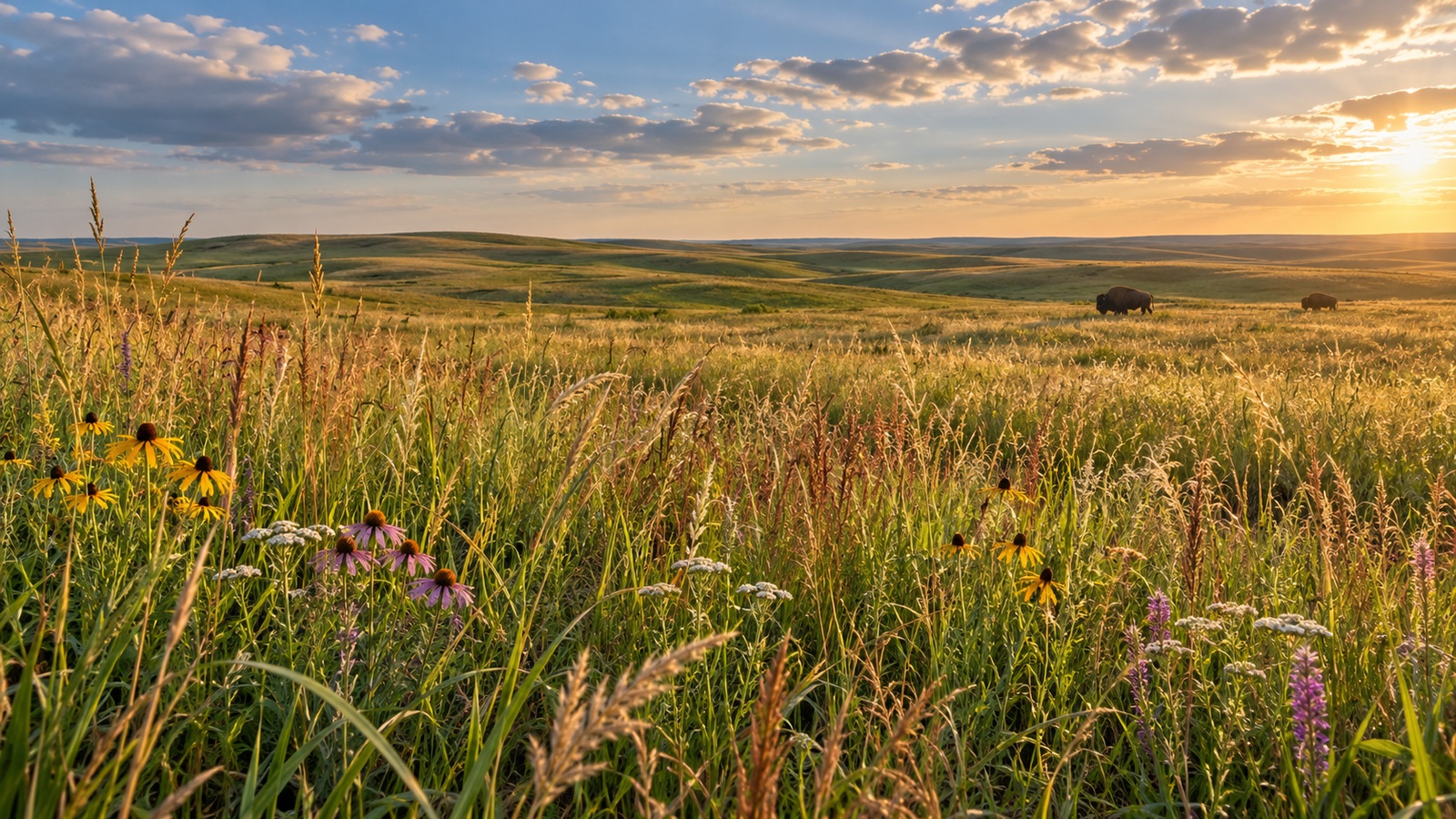
A grassland may look simple from a road: low vegetation, few trees, and a broad horizon. Much of its complexity appears closer to the plants or below ground. Grasses and wildflowers divide space and seasons, roots occupy soil, grazers change plant structure, and insects connect flowers with birds and other animals. Fire and rainfall influence which relationships persist, while soils retain a history of growth and disturbance. Many open landscapes have long ecological and cultural histories of their own. Their communities depend on conditions supporting grassland life, including the disturbance and reproduction that maintain openness. Prairies, steppes, pampas, and other grass-dominated systems differ in climate, species, soils, and use. Those differences shape how each supports wildlife, stores carbon, responds to grazing, and recovers after stress.
A: These nongrass herbaceous plants add flowering resources, varied growth forms, and foods that a uniform grass crop does not provide.
A: Native communities can contain many other herbaceous species.
A: Recovery depends on pressure, timing, resources, and species.
A: Plants access water through different depths and strategies.
A: Suitable fire patterns differ among ecosystems and objectives.
A: Different wildlife uses different vegetation structures.
A: Composition and ecological relationships can remain very different.
A: Lost soil functions can be slow and difficult to rebuild.
A: Fast regrowth can precede the return of long-lived native plants, habitat structure, and soil functions lost during disturbance.
A: Naturally open systems need assessment on their own terms.
Big bluestem grows among a much wider prairie community
In the North American tallgrass prairie, big bluestem, Indiangrass, and switchgrass are recognizable parts of a diverse plant community. The National Park Service’s tallgrass account describes these grasses alongside hundreds of species of flowering plants. Many such nongrass herbaceous plants are called forbs: familiar wildflowers belong to that group. The distinction matters because a grassland can be dominated visually by grasses while supporting a much richer set of foods, flowering periods, and growth forms. A field of one planted grass does not reproduce that community merely by sharing its height or color.
Flowers supply resources at particular times, grass leaves and stems create cover, and roots occupy different parts of the soil. Grazing or drought changes competition among those plants, allowing the species present to influence the stand’s next response. Tallgrass prairie combines relatively tall vegetation with its own seasonal water and disturbance history. Drier shortgrass systems and steppes contain different plants using more limited or differently timed resources. Their shared open appearance therefore includes a range of growth strategies, food supplies, and habitat structures, with each community developing through the conditions of its landscape.
Roots and growing points support persistence after disturbance
Many grasses retain growing tissues near the base of the plant, allowing regrowth after leaves are grazed or burned under suitable conditions. Perennial roots and storage structures support continued growth across seasons. These features help explain resilience to certain disturbances, but they do not make every grass immune to repeated severe use. Recovery depends on timing, intensity, water, and the plant’s remaining resources. A stand can lose vigor if demands repeatedly exceed its capacity to rebuild.
Roots hold living carbon below ground and add organic material when tissues die or release compounds. Microbes transform those inputs, using some for growth and releasing some through respiration. A grassland with little tall vegetation can therefore contain a substantial underground store built through many seasons. Cultivation, erosion, drought, and changing management alter both the inputs and their persistence. The store can increase where additions exceed losses or decline where organic material is removed or decomposes faster than it is replaced. Its history is carried in soil as well as in the living plants above it.
Grassland roots do not all occupy the same depth or use water in the same way. Some plants respond quickly to shallow moisture after rain, while others can draw on different layers or remain active during another part of the season. Soil depth and structure influence which routes are available. These differences change competition during a dry period and allow several growth strategies to coexist. A deep-rooted plant and a shallow-rooted neighbor can respond differently to the same shower, contributing to a community whose functioning is spread across more than one water supply.
A burst of green leaves after rain can come from plants with different histories beneath them. An established perennial may draw on roots and reserves that survived a dry period, while a disturbed patch may contain fewer long-lived native plants than before. Renewed growth then develops from a changed starting community. If repeated stress leaves too little time to rebuild reserves, plants can enter the next dry period with reduced capacity. Grassland persistence depends on that succession of growth and recovery, not only on how much foliage appears during a favorable week.
Water patterns help determine the kind of grassland present
Rainfall, temperature, soil, and evaporation determine the water available for grassland growth. A wet tallgrass system can produce a different canopy from a dry plain even though both remain open. In seasonal climates, moisture pulses trigger growth before plants slow or become dormant as water diminishes. A longer or more severe drought can reduce cover, kill sensitive plants, and expose soil to erosion. Rain returning afterward starts a new growth opportunity within whatever community remains. Some species recover rapidly, while lost perennials and disturbed soil can take longer to reestablish, leaving a legacy beyond the first flush of green.
Grazing changes both plants and habitat structure
Herbivores remove plant material, redistribute nutrients, disturb soil surfaces, and influence which plants compete successfully. Their effects depend on animal species, density, movement, season, and the opportunity for vegetation to recover. The presence of grazing is therefore not enough to classify a grassland as either healthy or degraded. A long history of mobile herbivores differs from continuous concentrated pressure on a small area. Local management needs to consider the pattern of use rather than only the number of animals visible during one visit.
Short and tall patches provide different conditions for wildlife. Some birds use relatively open, low vegetation, while others need taller stems or litter for nesting and shelter. Fire removes old material and grazing changes regrowth, creating variation across a prairie through their interaction. The National Park Service’s tallgrass prairie fire account describes fire as part of that living setting. A patch’s role also depends on its size and what surrounds it. Several small sheltered areas do not necessarily provide the same opportunities as a larger expanse used by species that avoid edges.
Fire can maintain openness while still requiring careful context
In many grasslands, recurrent burning influences litter, woody-plant establishment, light, and nutrient movement. The outcome depends on when and how fire occurs, the vegetation involved, and other pressures such as grazing or drought. Fire exclusion can change some systems, while overly frequent or poorly timed burning can harm others. An appropriate regime is an ecological pattern suited to the community, not a goal of burning as often as possible. Human stewardship has also shaped fire histories in many places. Recognizing Indigenous and other place-based management requires attention to authority, knowledge, and objectives, rather than reducing diverse practices to a generic fuel treatment copied between landscapes.
Insects and birds use a landscape measured in fine details
Wildflowers provide nectar and pollen, while stems, seeds, foliage, and litter offer resources to many invertebrates. Flowering at different times can help sustain insects across a season, though individual species still have particular requirements. A field dominated by one planted grass may offer cover while lacking the diversity of resources found in a native community. Pollinator value cannot be inferred from green area alone. The composition and seasonal continuity of plants are central to the comparison.
Grassland birds respond to vegetation height, density, patch size, nesting conditions, and the surrounding landscape. Fragmentation can expose nests to different risks or reduce the area suitable for species avoiding edges. A narrow roadside strip may retain useful plants but cannot automatically replace a large intact habitat. Conservation therefore needs both local vegetation management and attention to landscape scale. Maintaining small remnants can be valuable while still recognizing that they serve a different role from extensive connected grasslands.
Below the visible flowers, decomposers and soil organisms process organic material and influence nutrient availability. Burrowing animals can create additional habitat variation, while predators respond to the distribution of their prey. These relationships help explain why the loss of one component may alter functions beyond its own abundance. A grassland is not simply a grass crop with optional wildlife attached. Its organisms participate in a network of processes shaping the conditions that support continued plant growth and ecological diversity.
Intact cover influences soil and water movement
Vegetation and litter can protect soil surfaces, while roots and soil structure influence infiltration and resistance to erosion. These functions vary with slope, texture, moisture, and management. Where cover is lost, intense rain or wind may remove material that took a long time to develop. Recovering aboveground greenery does not immediately replace lost soil or restore every underground property. Protecting existing condition can therefore be more dependable than assuming that later reseeding will reverse all damage.
Water leaving a grassland carries the effects of the soil and cover it crosses. Vegetation and litter can slow overland movement and retain some sediment, while exposed or compacted ground can send water and material away more quickly. Runoff then connects the field with streams, wetlands, and downstream users. The effect changes with slope, soil, storm intensity, and the condition of the vegetation. Protecting cover helps maintain that relationship, while intense events and other sources in the catchment can still place pressure on receiving waters. Grassland contributes through its place in the drainage system rather than acting as an unlimited filter.
Conversion and simplification can remove long ecological histories
Cultivation, development, fragmentation, invasive plants, altered disturbance, and inappropriate use can change grassland communities. Some pressures remove habitat directly; others replace a diverse system with a simpler one that remains superficially grass-covered. Plowing can disrupt soil and eliminate established perennial communities, while invasive species can change fuel, competition, or seasonal resources. The effects differ by region and invader. A management response needs to diagnose the actual constraint instead of treating every decline as a shortage of grazing, fire, or seed. Where a system has crossed into a different state, recovery may require more than reversing the latest visible disturbance.
Konza Prairie gives grazing and diversity an observed relationship
At Konza Prairie in Kansas, a long-running experiment compared areas without large grazers, areas with year-round bison grazing, and areas with growing-season cattle grazing. A 2022 study reported by Kansas State University used more than three decades of observations and found roughly doubled plant diversity with bison relative to the ungrazed treatment. Cattle also increased diversity, though less in that comparison. These were specified management treatments in tallgrass prairie, not a finding that any grazer at any density improves every grassland.
When large herbivores remove some dominant grass, other plants can gain light and space. Movement, selective feeding, and local disturbance make the vegetation patchier, creating different opportunities within the same prairie. Konza’s long-running comparison followed those community changes through repeated seasons rather than one initial burst of growth. Bison, grasses, forbs, and fire continued interacting within the treatments. The result reflects a restored ecological relationship as well as the plants present. In another grassland, different soils, rainfall, species, or use patterns would shape a different interaction, because grazing acts on the particular community it encounters.
Open ecosystems deserve protection on their own terms
Grasslands matter through their roots, soils, diverse organisms, water relationships, and cultural and economic roles. Their value does not depend on becoming forests, and adding trees is not automatically an improvement where open conditions support distinctive communities. Nor does respecting grasslands mean assuming that every current practice is sustainable. The relevant task is to maintain the processes and relationships suited to the particular landscape. That requires observation, appropriate management, respect for local knowledge and rights, and protection of remaining intact areas. Once the apparent simplicity of an open horizon is replaced by a view of the living system beneath it, grassland conservation becomes easier to understand as care for a complete ecosystem rather than preservation of empty space.