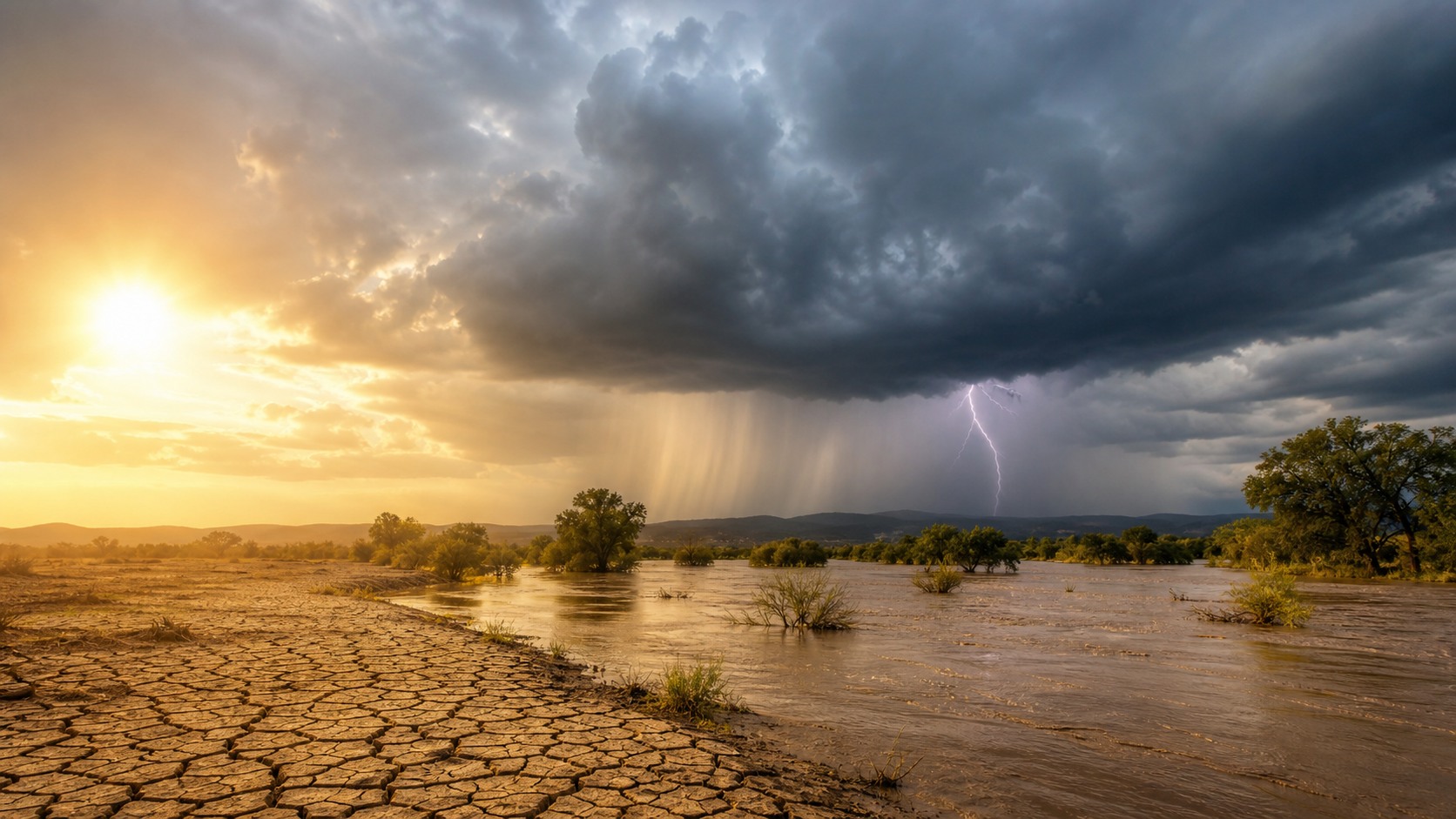
What Causes More Powerful Storms?
Storm power comes from heat, moisture, pressure differences, instability, wind structure, and the places storms strike. Here is how tropical cyclones and thunderstorms become more damaging.

Understanding a Changing Planet
Storm power comes from heat, moisture, pressure differences, instability, wind structure, and the places storms strike. Here is how tropical cyclones and thunderstorms become more damaging.
Climate change does not single-handedly cause every extreme event. It changes the odds, intensity, duration, moisture, heat, drought, fire weather, coastal flooding, and attribution picture.
Droughts, floods, and storms are linked by water, heat, pressure, and motion. This explainer looks at how scientists measure the mechanisms behind these hazards.
A beginner-friendly guide to extreme weather: what it is, common types, warning basics, and why risks are changing.
Droughts, floods, and storms are intensifying through shared climate drivers: hotter air, drier soils, warmer oceans, blocked weather patterns, heavier rain, and growing exposure.
A plain-English guide to the main causes of extreme weather, from heat and moisture to oceans, terrain, land use, climate change, exposure, and compound disasters.
A complete guide to polar ice loss, including Arctic sea ice, Greenland, Antarctica, ice shelves, glaciers, snow, albedo, ecosystems, and sea level impacts.
Polar ice loss is measured through a web of satellites, fieldwork, ice cores, ocean observations, and models. Here is how scientists track the mass balance, feedbacks, and hidden forces reshaping Greenland and Antarctica.
Polar ice melts through several linked drivers, from warm air and ocean heat to soot, sunlight, rain, wind, melt ponds, and glacier flow.
Polar ice is melting quickly, but speed means different things for Arctic sea ice, Greenland, Antarctica, and smaller ice caps. Satellites reveal both acceleration and uncertainty.
A beginner-friendly guide to ice loss, including sea ice, land ice, glaciers, ice sheets, reflectivity, meltwater, ecosystems, and why melting ice matters for people and nature.
Polar ice is melting through a web of warming air, ocean heat, darkened surfaces, melt ponds, shifting winds, and feedback loops that differ sharply between the Arctic and Antarctica.